How to Offer 3D Printing as a Service on Fiverr and Upwork
Discover how to transform your 3D printer into a profitable venture by offering services on top freelance platforms. This post guides you through setting up, marketing, and managing your 3D printing business on Fiverr and Upwork.

Ever look at your trusty 3D printer humming away, spitting out layer after beautiful layer, and think, "Man, this is amazing, but also, how do I make some actual cash with this thing?" Yeah, me too, bhai. Honestly, when I first got into 3D printing, it was pure passion. The smell of hot plastic, the magic of bringing a digital idea into the physical world – it was intoxicating. But after a while, you've printed all the silly desk toys, all the upgrades for your own printer, and then what? The dream, right? The dream is to turn that passion into a proper, sustainable business. And that's exactly what I've been trying to do here in India, running my little setup, ArtOpia, and guess what? Fiverr and Upwork have been absolute game-changers for finding clients, both locally and internationally. It's not always easy, trust me, there are definitely some hurdles, especially from India, but it's totally doable. So, let's talk about how you can actually offer your 3D printing as a service on these platforms.
I remember when I first considered offering my services online, I was skeptical. Would anyone even bother commissioning a 3D print from a guy in India? Wouldn't shipping costs kill any potential profit for international clients? And how do you even price something like this? It felt like a massive puzzle. But then I figured, what's the worst that could happen? So, I dove in, and it's been a wild ride. Over the past few years, I've printed everything from intricate prototypes for startups to custom cosplay pieces, even tiny architectural models. It's pretty cool, I won't lie. And these platforms, they connect you directly to folks who actually *need* your specific skill set.
Fiverr: Your Digital Showroom for 3D Printing Gigs
Let's kick things off with Fiverr. Now, the thing about Fiverr is it's very much a "gig" economy. You create a "gig," which is basically a service you're offering, and clients come to you. It's like having a little shop window for your 3D printing skills. You've got to make that window look inviting, you know?
Crafting Your Irresistible Gig
First up, your gig title. Make it clear, concise, and keyword-rich. Something like "I will 3D print your custom design or prototype with high quality" or "Fast & Accurate 3D Printing Service - PLA, PETG, ABS". Think about what people would search for. And then, the description. This is where you shine! Don't just list what you do; explain *how* you can solve their problem. Are they looking for a functional prototype? A detailed miniature? A replacement part for something broken? Tailor your language to their needs.
I personally always highlight my capabilities: multiple materials (PLA, PETG, even some flexible TPU if they need it), different colours, and my printer fleet. Currently, I'm mostly running a couple of upgraded Creality Ender 3 V2s and an Anycubic Kobra, which are workhorses, believe me. They give consistently good results once you've dialed them in. And mention your accuracy and attention to detail – people want to know their vision will be respected.
Pricing Your Gigs (The Indian Context)
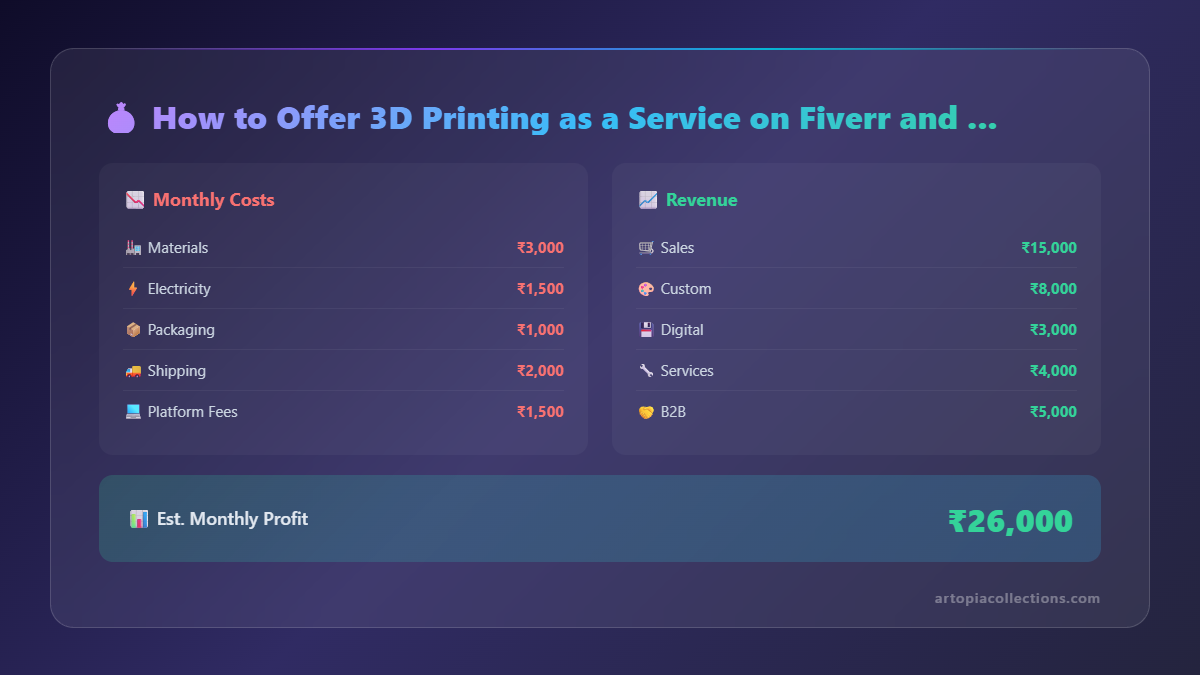 Okay, pricing. This is where it gets tricky, especially balancing competitiveness with making a profit. On Fiverr, you usually offer different packages: Basic, Standard, Premium. Think of it like this:
- Basic: Small print, simple design, maybe one colour PLA. For this, I might start at something like ₹500 for a print up to, say, 50g and 5 hours of print time. This covers basic material, electricity, and a tiny bit of my time.
- Standard: Medium print, more complex, maybe a different material like PETG, or a slightly larger size. This could be ₹1500-₹2500, depending on complexity and time.
- Premium: Large, intricate print, multiple parts, specific finish requirements, or maybe even post-processing like sanding or painting. Here, you're looking at ₹3000 and upwards, easily.
And don't forget to add "gig extras"! These are crucial for boosting your earnings. Things like:
- Faster delivery (e.g., "Get it printed in 24 hours" for an extra ₹300-₹500).
- Specific colour (if you don't stock it, you might charge a premium to buy a new roll).
- Design modifications or basic 3D modelling (charge hourly for this, maybe ₹800-₹1200 per hour, depending on your skill).
- Post-processing (sanding, painting, assembly).
- Material upgrade (e.g., from PLA to PETG, an extra ₹200-₹400).
The key here is to start a little lower to get some initial reviews, and then steadily increase your prices as you build your reputation. But never, ever, undervalue yourself too much. Your time, skill, and the electricity bill aren't free, remember?
Showcasing Your Work
This is probably the most important part of your Fiverr gig: the images and video. People are visual! You need high-quality photos of your best prints. Show variety – a detailed miniature next to a functional prototype, maybe something colourful, something practical. Take photos in good lighting, from multiple angles. A short video (even shot on your phone, but well-edited) showing your printer in action, or a 360-degree view of a print, can make a huge difference. It just adds that extra layer of professionalism and trust. And, if you've got them, include some satisfied client testimonials.
Upwork: Bidding for Bigger Fish
Upwork is a different beast altogether. Here, clients post jobs, and you, as a freelancer, submit proposals. It's more proactive, and in my experience, can lead to larger, more complex projects, sometimes even ongoing work. But it means you've got to be good at writing a compelling proposal.
Optimising Your Upwork Profile
 Before you even start bidding, make sure your profile is 100% complete and polished. Think of it as your online CV. Fill out every section: your skills (3D printing, CAD design, prototyping, product design, etc.), your experience, and definitely, your portfolio. Upload high-quality images of your best prints and designs. Showcase your diverse capabilities. And if you have any certifications or courses related to design or manufacturing, add those too. A strong profile makes clients more likely to open your proposals.
Crafting Winning Proposals
This is where the magic happens on Upwork. Don't just send a generic copy-paste proposal. Clients can spot those a mile away. Read the job description carefully. I mean, *really* carefully. Look for specific keywords or pain points they mention. Then, tailor your proposal directly to *their* needs. Here's my typical approach:
- Start with a hook: Reference something specific from their job post. "Hi [Client Name], I saw you're looking for a prototype of your new XYZ device, and I have extensive experience printing functional prototypes in PETG, which would be ideal for its application."
- Show, don't just tell: Briefly mention relevant past projects. "I recently worked on a similar project for a startup creating [type of product], where material choice and dimensional accuracy were critical."
- Ask clarifying questions: This shows you're engaged and thinking ahead. "Could you provide details on the intended use environment for the part? Is there a specific tolerance requirement?" This also encourages them to engage in a conversation.
- Outline your process: Briefly explain how you'd approach their project (e.g., "I'd start by reviewing your STL, suggest any potential optimizations for printability, then discuss material and colour options, and provide a clear timeline.").
- Pricing: Give an estimated range or a clear quote if you have enough information. You can bid hourly or fixed-price. For design work, I often do hourly (₹800-₹1500/hour depending on complexity). For printing, I usually give a fixed price after reviewing the files.
- Call to action: "I'm eager to discuss this further. Let's schedule a quick chat."
You get a limited number of "Connects" on Upwork, which are essentially tokens to submit proposals. So, don't just blindly bid on everything. Be strategic. Choose jobs where you truly feel you can deliver excellent value.
The Nitty-Gritty: Delivering Your Service (Both Platforms)
Okay, you've got a client! Now what? This is where your actual printing skills and professionalism come into play. Believe me, good communication can make or break a project.
Communication is King (or Queen!)
Always, always, be clear and prompt with your communication. Ask for everything upfront: the STL file (or other CAD files), desired material (PLA, PETG, ABS, TPU), specific colour, finish requirements, intended use of the part. Don't assume anything. If a client sends you a super complex model and expects it in 24 hours, you need to manage those expectations right away. Sometimes, I'll send a screenshot of the sliced model to confirm print orientation or support placement. It just builds trust.
Material Matters, and so do Brands
Here in India, we have access to a pretty good range of filaments. I mostly stick to PLA and PETG for general-purpose printing. PLA is super easy to print and great for visual models or less demanding parts. For functional prototypes or parts that need more strength and heat resistance, PETG is my go-to. I usually use brands like eSUN, Overture, or sometimes even local Indian brands like 3DPrintronics if I need something specific. You can find a good variety on Amazon.in. For example, check out some quality PLA filaments there. Just be sure to mention what materials you work with in your gig/profile.
Quality Control & Post-Processing
Once the print is done, it's not over. Inspect it thoroughly. No one wants to receive a print with major defects, stringing, or layer shifts. Do you need to remove supports? Sand it down? Clean it up? Sometimes a quick acetone vapor smooth for ABS or just some careful sanding can elevate a print from "okay" to "wow." This extra effort pays off in client satisfaction and reviews. And honestly, it feels good delivering something you're truly proud of.
Shipping from India: The Big One
This is probably the biggest challenge for us in India, especially for international clients. Shipping costs can be substantial, and delivery times can be long. Here's how I handle it:
- Be Transparent: Always, always, include shipping costs in your quote or clearly state that shipping will be an additional cost calculated after printing.
- Local Clients: For clients within India, I use reliable courier services like Delhivery, Bluedart, or even India Post for smaller, non-urgent items. Costs are manageable, usually ₹100-₹300 for most prints within a city, slightly more for inter-state.
- International Clients: This is tougher. Options include DHL, FedEx, or India Post's EMS. DHL and FedEx are fast and reliable but expensive (often ₹1500-₹3000+ for a small package, depending on destination). India Post EMS is cheaper but slower and sometimes less predictable. I typically advise clients on the options and let them choose based on urgency and budget. Ensure you factor in good packaging to protect the print during transit.
And yes, remember customs duties for international shipments. Usually, the recipient pays these, but it's good to inform the client upfront so there are no nasty surprises.
My Own Work & Portfolio
One thing that has helped me immensely, beyond these platforms, is having my own online space to showcase my work. It adds credibility and gives clients a glimpse into my style and capabilities. I'm building out my own little collection of interesting designs and prints at ArtOpia Collections. It's a great way to not just show off your best pieces, but also to sell some of your unique designs directly. Having a diverse portfolio across multiple platforms is a powerful combination!
A Few Final Thoughts from My Experience
- Don't Underprice Yourself: Seriously, your time, skill, material cost, electricity, and even the wear and tear on your machine – it all adds up. Factor in the platform fees too (Fiverr takes 20%, Upwork has a tiered fee structure).
- Build Relationships: Treat every client like gold. Good communication, timely delivery, and excellent quality lead to repeat business and great reviews, which are priceless on these platforms.
- Always Be Learning: New filaments, new slicing techniques, new printer upgrades – the 3D printing world is always evolving. Stay curious, stay updated. I’m always tinkering with my 3D printer tools to get better prints.
- Manage Expectations: Not every print will be perfect, and not every client will be easy. Be honest about limitations (e.g., "This design has very thin walls, so it might be fragile," or "Layer lines will be visible on FDM prints.").
- It's a Marathon, Not a Sprint: Building a strong reputation takes time. Don't get discouraged by initial slow sales or a difficult client. Keep refining your gigs, proposals, and skills.
So there you have it, folks. Offering 3D printing as a service on Fiverr and Upwork from India is absolutely viable. It takes effort, a bit of strategic thinking, and a whole lot of passion for what you do. But honestly, the satisfaction of turning a client's idea into a tangible object, knowing your printer (and your skills!) made that happen, is truly something special. Good luck, and happy printing!