Dropshipping 3D Printed Products: Does It Actually Work?
Dropshipping 3D printed products sounds like a modern e-commerce dream, but does it truly deliver? We delve into the feasibility, challenges, and potential of this unique niche market to see if it's a viable business model.

Dropshipping 3D Printed Products: Does It Actually Work? A Hard Look from a Printer in India
Okay, so let’s be honest. How many of you, like me, have scrolled through Instagram or Facebook, seen those gurus flashing their fancy cars, talking about "passive income" and "dropshipping freedom," and thought, "Could this actually work for my 3D printing business?" Yeah, me too. A lot. It's a shiny, tempting idea, isn't it? The thought of selling custom 3D printed goodies without actually owning a farm of printers, managing inventory, or dealing with the late-night print failures – sounds like a dream, right?
But here’s the deal, guys. As someone who lives and breathes 3D printing here in India, running my small business, Artopia Collections, from my little workshop (which is basically a corner of my garage overflowing with filament spools and the hum of my beloved machines), I’ve had my fair share of curiosity, and frankly, a bit of a reality check when it comes to dropshipping 3D printed products. I mean, I’ve been at this for years, started with a single Ender 3, then added an Anycubic, and now I’ve got a small squadron humming away, turning digital dreams into tangible objects. I’ve seen the trends come and go, tried new materials, burnt my fingers (literally, on a hot nozzle once – don’t ask), and learned a ton.
The Dropshipping Promise: Too Good to Be True?
The core idea of dropshipping is beautiful in its simplicity: You set up an online store, market products, and when someone buys something, you forward the order to a third-party supplier who then prints and ships the item directly to your customer. You never touch the product. You avoid inventory costs, storage, and all the logistical headaches. The profit is the difference between what your customer pays you and what you pay the supplier. Sounds amazing, especially for 3D printed stuff where customization and variety are key. You could, in theory, offer thousands of different designs without ever printing a single one yourself.
I remember sitting there, late one night, surrounded by cooling prints, sketching out business plans. Imagine! I could sell intricate miniature models, custom phone stands, unique home decor, maybe even some specific industrial prototypes – all without needing a bigger workshop or more printers. The potential seemed endless. I started looking for suppliers, lurking in Facebook groups, checking out platforms that offered 3D printing services, both locally and internationally. And that’s when the first cracks started appearing in the "passive income" facade.
My Personal Dive into the Deep End (and Why I Swam Back)
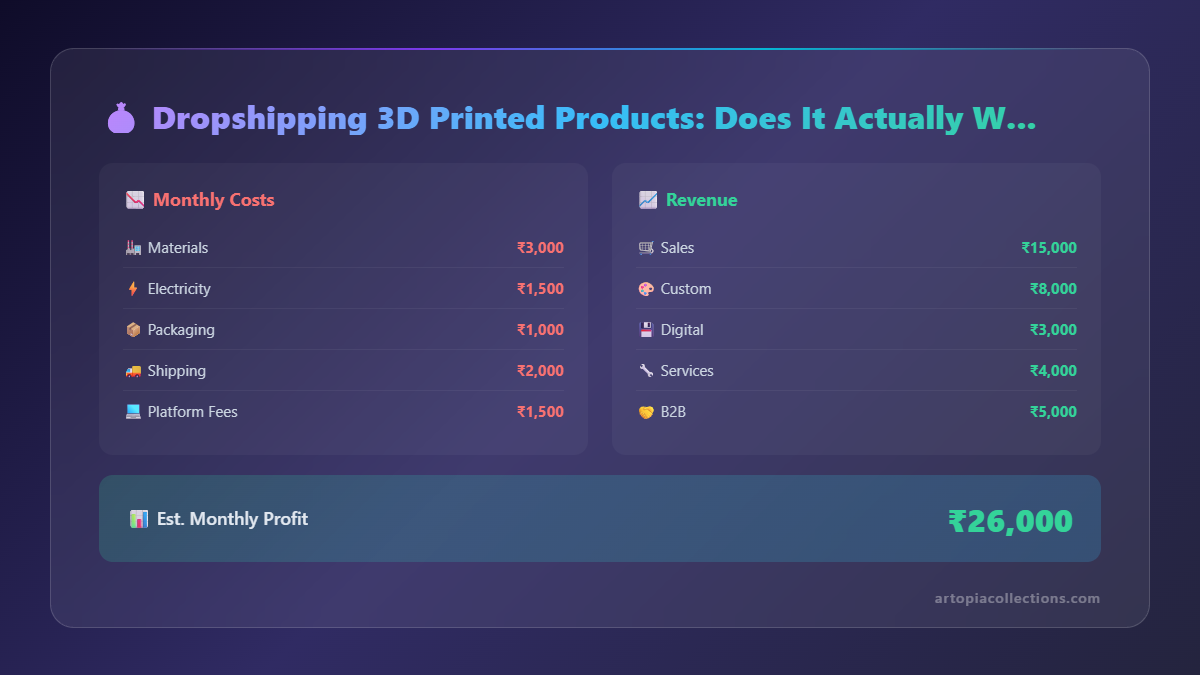 I actually tried a tiny experiment. I found a few potential "suppliers" – basically, other small 3D printing businesses, some even hobbyists, who were willing to take on overflow work or specific prints. The idea was to list some unique, trending items on a small online storefront I set up, take orders, and then pass them on. For instance, those popular articulated dragon toys, or some custom keychains.
The first few orders came in, and I was genuinely excited. I’d forward the STL, tell them the colour, material (usually PLA, because it’s easy and affordable), and provide the shipping details. I’d charge the customer, say, ₹800 for an articulated dragon. My "supplier" quoted me ₹500 including shipping. That’s a decent ₹300 margin, right?
But then the problems started. And trust me, they started almost immediately.
1. The Quality Control Nightmare
This is, without a doubt, the single biggest killer of dropshipping 3D printed products. When you print something yourself, you know your machines. You know your filament. You know your settings. You can spot a layer shift, stringing, or an elephant's foot a mile away. You can fine-tune, reprint, and ensure perfection before it leaves your hands. With dropshipping, you're literally gambling on someone else's printer, someone else's expertise, someone else's filament quality, and someone else's attention to detail.
One time, a customer received a dragon that had massive layer lines, some ugly stringing, and a wobbly head. Not what they paid for. They sent me pictures, and honestly, I was embarrassed. I had to issue a full refund and apologize profusely. I never even saw that print, you know? How could I guarantee the quality when it was completely out of my hands? And it happened again with a custom keychain – the text was barely legible because of bad printer calibration. It just felt like I was constantly letting my customers down, and that’s not how I run my business.
When you're dealing with delicate items like 3D prints, where aesthetics and functional precision matter so much, blindly trusting another printer is a huge risk. My reputation, which I've worked so hard to build, was on the line with every single order.
2. Production & Shipping Timelines: The Waiting Game
3D printing isn't like picking an item off a shelf. It takes time. Even a relatively small, simple print can take hours. Larger, more complex items can take days. Add to that the "supplier's" existing workload, potential machine breakdowns, and the time it takes for them to package and ship. What I found was that the promised delivery times were often wildly inaccurate. A "3-5 business days" often turned into 7-10, sometimes even more.
Customers, especially in today's Amazon Prime world, expect fast delivery. When I promise 7 days and it takes 15, they're understandably annoyed. And tracking? Forget about consistent, reliable tracking if you're relying on a small-time printer using local courier services. It's a mess, and you, as the "seller," are stuck in the middle, trying to placate an impatient customer while chasing down an unresponsive supplier. This is doubly true if you’re trying to use international suppliers, which brings its own set of customs and shipping nightmares to India.
Honestly, it felt like I was running a customer service department for other people's problems. It was draining.
3. Razor-Thin Profit Margins (Especially in India)
The math often doesn't add up for 3D printed items. My hypothetical ₹300 margin on a ₹800 product sounds okay. But what if the customer returns it? That’s ₹800 gone, plus my time, and the supplier has already been paid. What about platform fees (if you're using Etsy or Shopify, or even just payment gateway charges)? What about marketing costs to even get that order? Suddenly, that ₹300 disappears faster than a filament spool on a big print job.
Here in India, prices for 3D printing services can vary wildly, but competition is fierce. If a supplier is offering really low prices, it often means they're cutting corners on filament quality (using cheaper, brittle stuff) or not spending enough time on post-processing. And if they're charging a fair price, your margin gets squeezed into oblivion. For example, a spool of good quality eSUN PLA filament can cost anywhere from ₹1200-₹1800. My electricity bill for running multiple printers for hours? That adds up. My time for design, slicing, and post-processing? That’s valuable. Trying to factor all that into a dropshipping model where you're already giving a cut to a third party, and then hoping for a profit, is just tough.
4. Finding Reliable Suppliers: A Needle in a Haystack
This was the biggest roadblock. Most decent 3D printing services already have their own client base. Why would they prioritize a dropshipper's sporadic, low-margin orders? The ones who are willing to dropship often fall into two categories:
- Newbies looking for any work, who might not have the experience or quality standards.
- Those who are struggling to find work, which can sometimes (not always) indicate issues with their service or quality.
So, Does It EVER Work? Maybe... With a Catch.
Look, I'm not saying dropshipping 3D printed products is an *absolute* impossibility. But it's certainly not the "passive income dream" that's often peddled. It *might* work in extremely niche scenarios, or with a very specific, carefully structured setup:
- Hyper-Local Dropshipping: Imagine you have a network of known, trusted 3D printers in your city. You've personally vetted their quality. You take orders, they print, and you handle local delivery. Even then, it’s basically white-label manufacturing, not true dropshipping as most people understand it.
- Specific Niche with High Margins: If you find a super unique, high-value 3D printed product that can command a premium price (think artistic pieces, or highly specialized industrial parts where the design is the main value), and you find a supplier who can consistently deliver quality, *maybe*. But these are rare.
- Dropshipping *NON*-3D Printed products related to 3D printing: This is where dropshipping makes more sense for a 3D printing business. If you sell 3D printed products, but you also want to offer accessories like tools, resins, or even entry-level 3D printers that you don't stock, dropshipping those *non*-printed items can work. The quality control issues are much less, and established suppliers for these kinds of goods are plentiful.
My Approach: Quality Over Quantity, Control Over Chaos
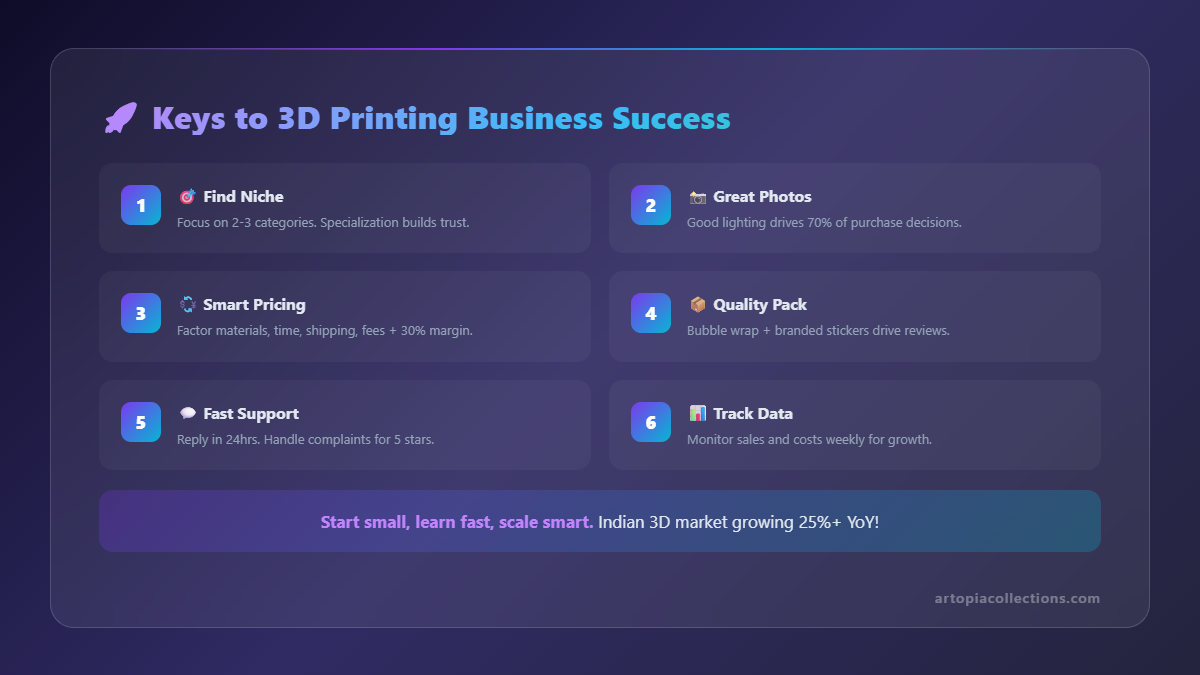 After my little experiment, I quickly realized that for my business, Artopia Collections, success hinges on quality, reliability, and the personal touch. I want every single product that leaves my workshop to be something I’m proud of. That means I print almost everything myself, right here in my garage in India. From custom lithophanes to intricate tabletop gaming terrain, each piece gets my full attention.
I invest in good machines – I'm a big fan of my Creality machines, they’re workhorses, and I even splurged on a Prusa Mini+ last year, which is just fantastic for precision. And I don’t skimp on filament; I use brands I trust, whether it’s a locally sourced, high-quality PLA or something like Overture. This ensures that when a customer places an order, they're getting the best possible print. You can check out some of the stuff I make and sell directly on my website. It's all printed by me, with love and a lot of patience!
Sometimes, if I get a really big order, or a complex one that requires a specific type of machine I don't have, I might outsource a small part of it. But even then, I only work with one or two local printers whom I know personally, whose workshops I've visited, and whose quality I've seen firsthand. It’s more like a partnership, not true blind dropshipping.
My Honest Advice for You
If you're a 3D printing enthusiast in India (or anywhere, really) looking to start a business, here’s what I genuinely recommend:
- Start by Printing Yourself: Get good at 3D printing. Really good. Learn your machines (like an Ender 3, it’s a great starting point!), understand materials, master your slicer. Build a reputation for excellent quality.
- Focus on a Niche: Don't try to sell everything. Find something you're passionate about printing, or something that fills a specific market need. Customization is your superpower here.
- Build Your Brand: Customers buy from people they trust. Showcase your work, show your process, be transparent.
- Price for Profit and Quality: Don't undersell yourself. Factor in material costs, electricity, wear and tear on your printer, and most importantly, your time and skill. A good quality print is worth a fair price.
- Consider a Hybrid Model (Carefully): If you absolutely must, dropship accessories or complementary items, not your core 3D printed products. Or, if you find a truly reliable, vetted local printing partner, explore a very structured, quality-controlled partnership. But don't expect it to be "passive."
The "get rich quick" promises of dropshipping often fall flat, especially when you're dealing with a craft as intricate and quality-dependent as 3D printing. For me, the joy of this business comes from creating something tangible, seeing a design come to life, and knowing that I personally ensured its quality before it reached my customer's hands. That satisfaction, and the trust I build with my customers, is worth far more than any fleeting, risky dropshipping margin.
So, does dropshipping 3D printed products actually work? In my experience, and from what I’ve seen in the Indian market, it’s an uphill battle fraught with quality control nightmares and customer service headaches. Stick to what you know, focus on quality, and let your printers hum. That's where the real magic (and sustainable business) happens.


