Elegoo Centauri Carbon Review: New Competition for Bambu Lab?
The Elegoo Centauri Carbon enters the 3D printing arena, promising high-speed performance. We put this new machine to the test to see if it can truly challenge the industry leader, Bambu Lab.

Chalo, listen up, everyone! There's a new beast roaring onto the 3D printing scene, and honestly, my feed is absolutely blowing up with the chatter. We’re talking about the Elegoo Centauri Carbon, and the big question on everyone’s lips – especially here in India where every rupee counts – is simple: Is this it? Is this the printer that finally gives Bambu Lab a run for its money, or dare I say, even becomes a Bambu Lab *killer*?
You know me, right? I’m Vidyut. Been obsessed with 3D printing for years, turned that obsession into Artopia Collections, my little venture making custom parts and prototypes, and just generally trying to push the boundaries of what we can do with these amazing machines. I’ve seen printers come and go, from the early Prusa clones to the Creality era, and now, the high-speed, multi-material revolution. And believe me, when something new pops up that promises to shake things up, my ears perk right up. My wallet? Not so much, but my inner printing geek is practically doing a bhangra.
The Bambu Lab Effect: A Game Changer, No Doubt
Let's be real for a minute. Before Bambu Lab stormed onto the scene a couple of years ago, high-speed, multi-material, out-of-the-box reliable printing was mostly a dream for the average hobbyist or small business like mine. You had your Prusas, which are fantastic, don't get me wrong, but they weren't exactly pushing ludicrous speeds. Then there were the CoreXY machines, mostly DIY or pro-grade Klipper beasts that required a fair bit of tinkering. Bambu Lab came in with their P1P, P1S, and X1C, and they just… changed the game, boss. Suddenly, you could print fast, with multiple colours, and often, without tearing your hair out figuring out firmware or bed leveling.
Here in India, the Bambu Lab printers quickly became aspirational. The P1S, with its enclosure and decent price point for what it offers, runs somewhere around ₹80,000 to ₹1,00,000 depending on where you get it and if you snag a deal (and trust me, I'm always looking for those deals). The X1C, with its LiDAR and fancy interface, well, that's pushing ₹1,20,000 to ₹1,50,000. That’s a significant investment, especially for a small business or someone just getting into the hobby. But the thing is, they justified it with performance. The speed, the reliability, the AMS (Automatic Material System) – it just works. And for someone running a business, 'it just works' is worth a lot of peace of mind.
I’ve printed so many things for clients – intricate prototypes, strong functional parts, even multi-color aesthetic pieces – that would have taken ages on my older machines. My clients love the turnaround time, and honestly, so do I. It’s hard to go back once you experience that kind of efficiency.
Enter the Elegoo Centauri Carbon: A New Challenger Appears
So, when Elegoo, a company I already know and trust from their resin printers (their Mars and Saturn series are staples in many print farms, including mine for certain jobs), announced the Centauri Carbon, you bet I sat up straight. Elegoo has a reputation for delivering solid performance at competitive prices in the resin world. Could they do it again for FDM?
From what I’ve seen so far, the Centauri Carbon is Elegoo’s clear shot at the high-speed, multi-material market dominated by Bambu Lab. It's a CoreXY machine, which immediately tells you it's built for speed and precision. It features an enclosed chamber right out of the box, which is HUGE for printing engineering filaments like ABS, ASA, Nylon, and especially those carbon fiber reinforced materials that warp if you just look at them wrong. No need for DIY enclosures or extra upgrades – it’s ready for the serious stuff.
Key Features That Caught My Eye:
- CoreXY Kinematics: This is basically a non-negotiable for high-speed printing. It's stable, precise, and reduces ringing significantly.
- Enclosed Build Volume: Critical for advanced materials. Printing functional parts from ABS or PC-CF without an enclosure is a nightmare, yaar. Warping, layer delamination – it’s a mess.
- Multi-Material System (MMS): Elegoo's answer to the AMS. This is the real battleground. How many colours? How reliable are the changes? Does it purge effectively? These are the questions we need answers to.
- High-Temperature Nozzle: Essential for exotics. I'm talking about printing with something like Nylon-CF or even ULTEM – these need higher temperatures than your typical PLA or PETG.
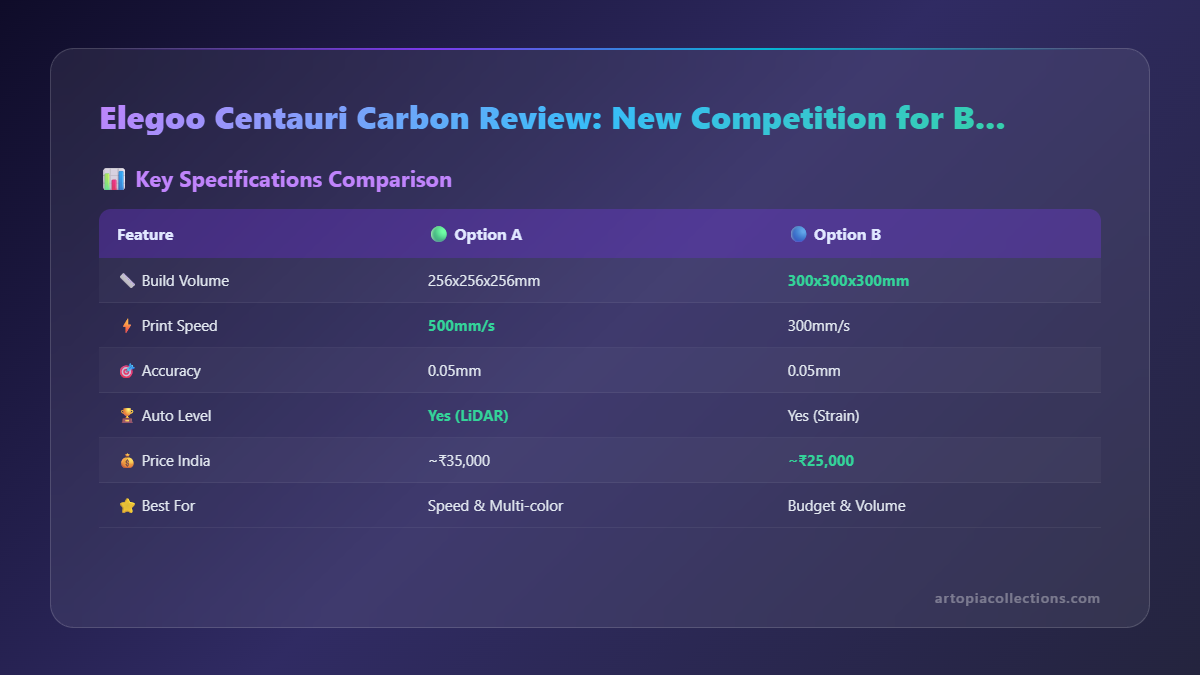
- Large Build Volume (reportedly): While not confirmed, if it's larger than the Bambu Lab X1C's 256x256x256mm, that's a big plus for industrial applications or larger prototypes.
And the aesthetics? From the renders, it looks slick. Modern, clean lines, probably with some LED action, because who doesn't love a bit of flair in their workshop, right?
Elegoo Centauri Carbon vs. Bambu Lab: Head-to-Head (Speculation Edition)
Alright, let’s get down to the brass tacks. Is it really competition? Here's my take, based on what we know and what Elegoo usually brings to the table:
Speed & Performance:
Bambu Lab printers are known for their acceleration and speed. My P1S screams through prints. The Centauri Carbon, being a CoreXY, should theoretically be able to match or even exceed those speeds. The devil, however, is in the details: the motor quality, the firmware optimization, the extruder design. Elegoo has a challenge here to fine-tune everything to deliver that buttery-smooth, lightning-fast experience that Bambu Lab has perfected.
Multi-Material System:
 This is where Bambu Lab truly shines with its AMS. It's generally reliable, handles different filament types fairly well (though not perfectly, mind you), and the software integration is excellent. Elegoo's MMS needs to be equally robust. If it can handle 4+ colours, swap reliably, and integrate seamlessly with their slicer, they've got a winner. My biggest concern here would be the complexity; the more moving parts, the more potential points of failure. But if they've engineered it well, it could be a game-changer for folks wanting multi-material capabilities without going the Prusa MMU route (which, in my experience, can be a bit finicky).
Enclosure & Advanced Materials:
This is where the Centauri Carbon has a distinct advantage over, say, a stock P1P. The P1S comes with an enclosure, and the X1C also has it, but an enclosed chamber *designed* for advanced materials is crucial. I'm talking about materials like eSUN ePA-CF or 3DXTech CarbonX CF-Nylon. These filaments require stable, higher chamber temperatures to prevent warping and ensure strong layer adhesion. If Elegoo has truly optimized the Centauri Carbon for these materials, with active heating or excellent insulation, it could appeal strongly to engineers, product designers, and small businesses like mine that often need to print strong, stiff, lightweight parts.
I mean, look, printing a part for a drone or a custom jig for my workshop often demands something beyond just PLA. I need durability, heat resistance, and stiffness. For those jobs, I often turn to ASA or Nylon-CF, and having a printer that’s purpose-built for it, right out of the box, is a massive win. You can find some fantastic engineering filaments on Amazon.in here, but you need the right machine to handle them, you know?
Software & Ecosystem:
 Bambu Studio (based on PrusaSlicer) and their Bambu Handy app are quite polished. They make the printing experience smooth. Elegoo has their own slicer, which has been evolving for their resin printers. They'll need to deliver a similarly user-friendly and feature-rich experience for the Centauri Carbon. Cloud connectivity, print monitoring, remote control – these are standard expectations now. A clunky software experience can ruin even the best hardware.
Price Point: The Ultimate Differentiator
Here's the deal, the MOST important factor for the Indian market, and for small businesses everywhere. If Elegoo positions the Centauri Carbon significantly cheaper than a Bambu Lab X1C (say, ₹20,000-₹30,000 less) while offering comparable features and performance, then yes, it's a serious contender. If it lands too close to the X1C’s price, Elegoo will have a tougher battle, because Bambu Lab already has a proven track record.
My hope is that Elegoo leverages its manufacturing scale and competitive pricing strategy from the resin world. If they can bring a fully enclosed, multi-material CoreXY printer to India for around ₹90,000 to ₹1,10,000, they could seriously disrupt the market. Imagine getting all that capability for the price of a P1S combo, maybe even less!
My Personal Take: Is it a "Bambu Lab Killer"?
Honestly? "Bambu Lab killer" is a strong phrase, and frankly, I don't think any single printer is truly going to "kill" Bambu Lab overnight. What it *will* do, however, is provide much-needed competition, which is always a good thing for us consumers. It pushes everyone to innovate faster, improve quality, and hopefully, bring prices down.
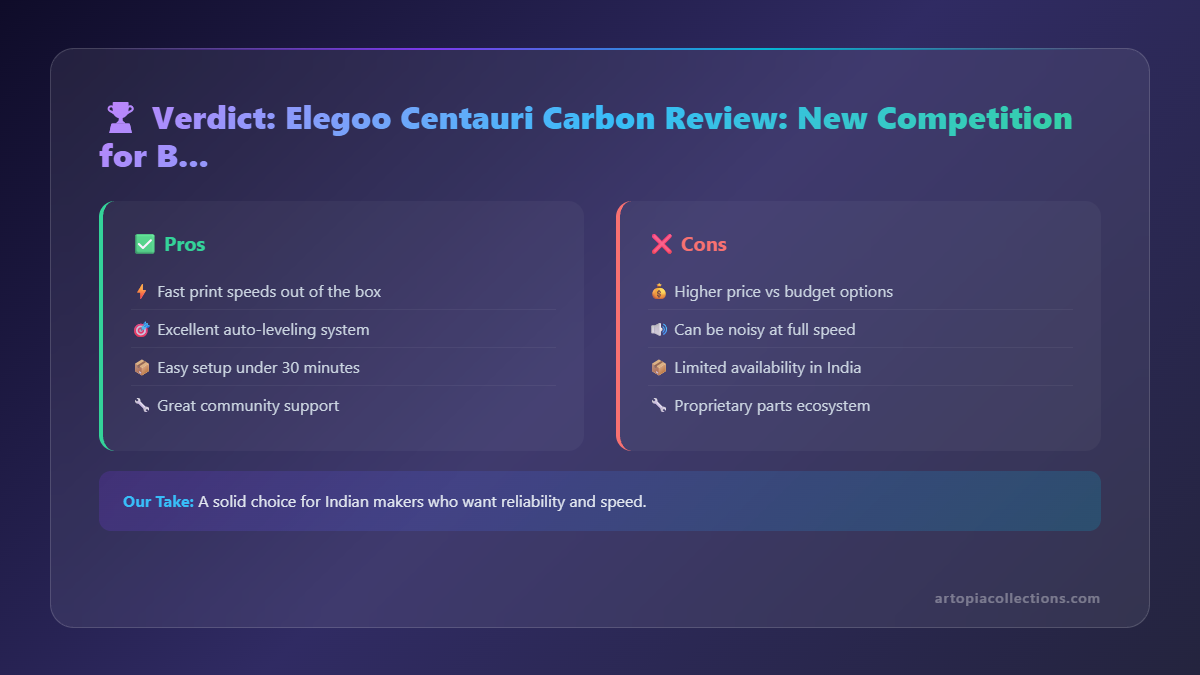
I personally think the Elegoo Centauri Carbon has the potential to be a very strong alternative. Especially if it delivers on the promise of robust engineering filament support and a competitive price. For my business, needing to produce high-strength functional parts often, an enclosed, multi-material CoreXY from a reputable brand at a good price point is incredibly appealing. It’s about expanding capabilities without breaking the bank.
I’m also very curious about the long-term reliability and support network here in India. Bambu Lab is still finding its feet here, and Elegoo will need to do the same. Spare parts availability, local service centers – these are big considerations for businesses like mine. No one wants to wait months for a replacement hotend or a new print bed.
And let's not forget the filaments! While Elegoo is known for resins, they'll need to ensure their FDM ecosystem supports a wide range of filaments. I mostly use eSUN, Overture, and some locally sourced PLA+ for general prints (you can grab some great eSUN PLA+ on Amazon.in). But for advanced prints, I need specific brands and types, and the printer needs to handle them without fuss.
This is an exciting time in 3D printing, folks. The race for speed, reliability, and advanced material handling is heating up, and Elegoo stepping into the ring is fantastic. It means more choices for us, and hopefully, more affordable, high-performance machines entering the market. And that, bhai, is always a good thing.
What do you all think? Are you hyped for the Centauri Carbon? Do you think it can dethrone Bambu Lab, or will it be another strong contender in a growing market? Let me know in the comments! And hey, if you're ever looking for some custom 3D printed parts or prototypes – anything from functional jigs to artistic pieces – you know where to find me. Check out some of our past work and custom print services right here: Artopia Collections. We’re always ready for a new challenge!


