Prusa MK4 vs Bambu Lab P1S: European Precision vs Chinese Speed
Deciding between the Prusa MK4 and Bambu Lab P1S? This post breaks down the European precision of Prusa against the Chinese speed of Bambu Lab, helping you choose the best 3D printer for your needs.

Chalo yaar, let’s be real. If you’re anything like me, running a 3D printing business here in India, you know the struggle. Every single Rupee counts, and every minute of printer downtime feels like a punch to the gut. The internet, bless its heart, is a glorious mess of opinions, especially when it comes to the machines that make our dreams a reality. And right now, the biggest, loudest debate echoing through every forum and YouTube channel is between two titans: the Prusa MK4 and the Bambu Lab P1S. European precision versus Chinese speed. It’s like choosing between a classic Royal Enfield for its legendary reliability and a lightning-fast KTM Duke for its sheer thrill. Both awesome, both expensive, and both capable of doing incredible things. But which one is truly right for *your* business, especially when operating out of a bustling city like Bangalore or a quieter town in Rajasthan?
The Age-Old Question: Prusa or Bambu?
For years, Prusa was basically the king. Everyone knew it, everyone respected it. Josef Prusa, the man, the legend, built an empire on open-source philosophy, rock-solid engineering, and a commitment to quality that was almost unmatched. Then, out of nowhere, Bambu Lab bursts onto the scene like a super-fast bullet train, promising speeds and features that made our trusty Prusas look, well, a little slow. Suddenly, it wasn't just about 'can it print?' but 'how fast can it print?' and 'how many colors can it print at once?'
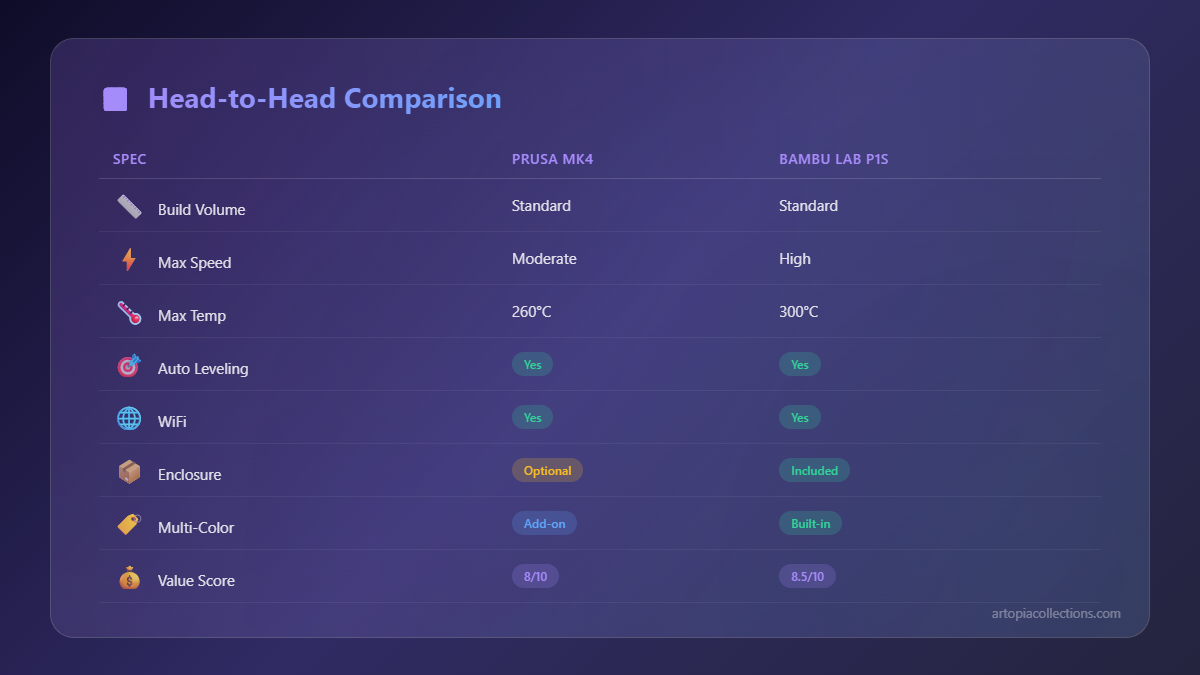
Now, I’ve had my hands on both, spent countless hours tweaking, calibrating, and just plain watching these machines hum away. And honestly, it’s not a simple 'this one is better than that one' kind of answer. It's nuanced, like the perfect masala chai – everyone has their own recipe for what makes it great. Let’s dive deep, eh?
Prusa MK4: The European Workhorse – Precision in Every Layer
Alright, let’s talk Prusa MK4. My initial reaction? It felt like coming home. You know that feeling when you drive a car that just *feels* right, solid, dependable? That’s the Prusa. It’s not flashy, it’s not screaming for attention, but it exudes confidence. When you unbox it (or, in my case, spend a joyful weekend building the kit – which is an experience in itself, believe me, you learn so much about how these things actually work!), you immediately notice the build quality. The components are robust, well-machined, and you can just *feel* the engineering behind it. This isn't just about slapping parts together; it's about designing a machine that lasts.
What I love about the Prusa MK4:
- Unparalleled Reliability: This is crucial for a business. I need my machines running consistently, day in and day out. The MK4 is a tank. It just keeps going. And if something *does* go wrong, diagnosing it is often straightforward because of its open-source nature and the massive community support.
- Print Quality: The prints it produces are just… *chef's kiss*. Layer lines are minimal, tolerances are fantastic. For intricate models, prototypes, or anything where surface finish is paramount, the MK4 consistently delivers.
- Open-Source Ecosystem: This is a big deal for me. Being able to understand the firmware, tinker with settings, and know that spare parts are readily available and often interchangeable with third-party components is liberating. You're not locked into a proprietary system.
- Support & Community: Prusa's customer support is legendary, and the online community is a goldmine of information. Any problem you encounter, chances are someone else has faced it and found a solution.
- Made in EU: While it might mean a slightly higher price tag and potentially longer shipping times for parts sometimes, it also speaks to a certain standard of manufacturing.
The Flip Side (because nothing is perfect, right?):
- Speed: Okay, let's not beat around the bush. Compared to Bambu, the MK4 isn't a speed demon. It's fast for a traditional FDM printer, absolutely, but it's not breaking any land-speed records. For large batches or quick prototyping where speed is *the* priority, you might feel its pace.
- Price: A Prusa MK4 kit will set you back around ₹95,000 to ₹105,000, and the assembled version even more. That’s a significant investment for a small business here in India. You can find their official pricing on their website, but you'll also factor in import duties and shipping.
- Learning Curve: While the Prusa is user-friendly, it’s still more hands-on than a Bambu. You're expected to understand more about calibrating, maintaining, and troubleshooting. For a beginner, this can be a steeper climb, though it makes you a much better 3D printer operator in the long run.
In my experience, the MK4 is for the kind of business that prioritizes consistent, high-quality output and doesn't mind a slightly slower pace. It’s perfect for functional parts, bespoke items, or anything where reliability is king. We use ours extensively for custom enclosures and mechanical prototypes. If you want to dive deeper into the world of filament, I highly recommend checking out eSUN PLA on Amazon.in – it’s a staple for us, great quality and value.
Bambu Lab P1S: The Chinese Bullet Train – Speed and Convenience
Now, let's talk about the Bambu Lab P1S. This machine, particularly with the AMS (Automatic Material System), is a game-changer. When it first came out, everyone was talking about it. And for good reason. It’s fast. Like, *really* fast. And it's designed to be incredibly easy to use, almost plug-and-play (well, maybe not *entirely* plug-and-play, but pretty darn close). The P1S is basically a more affordable version of their flagship X1C, packing many of its core features into a slightly less premium package, but still delivering incredible performance.
What I absolutely dig about the Bambu Lab P1S:
- Blazing Fast Speed: This is its superpower. For rapid prototyping, printing large batches of parts, or just getting a print done ASAP, nothing in its price range comes close. The P1S just flies.
- AMS (Automatic Material System): Oh my god, the AMS. Being able to print in multiple colors or with different materials seamlessly is incredible. For aesthetic prints, multi-color logos, or even support structures in a different material, it’s revolutionary. This capability alone can open up new avenues for your business.
- Enclosed Chamber: The P1S comes with an enclosed chamber right out of the box, which is fantastic for printing materials like ABS, ASA, or Nylon. It helps maintain a stable temperature, reducing warping and improving print quality with these trickier filaments.
- Ease of Use: This printer is designed for minimal fuss. Automatic bed leveling, flow calibration, and generally just hitting print and walking away. For a business where time is money, this convenience is a massive advantage.
- Active Noise Cancellation: While still not silent, it's remarkably quiet for how fast it moves. This matters if your printer is in a shared workspace.
The Downsides (because again, balance, yaar):
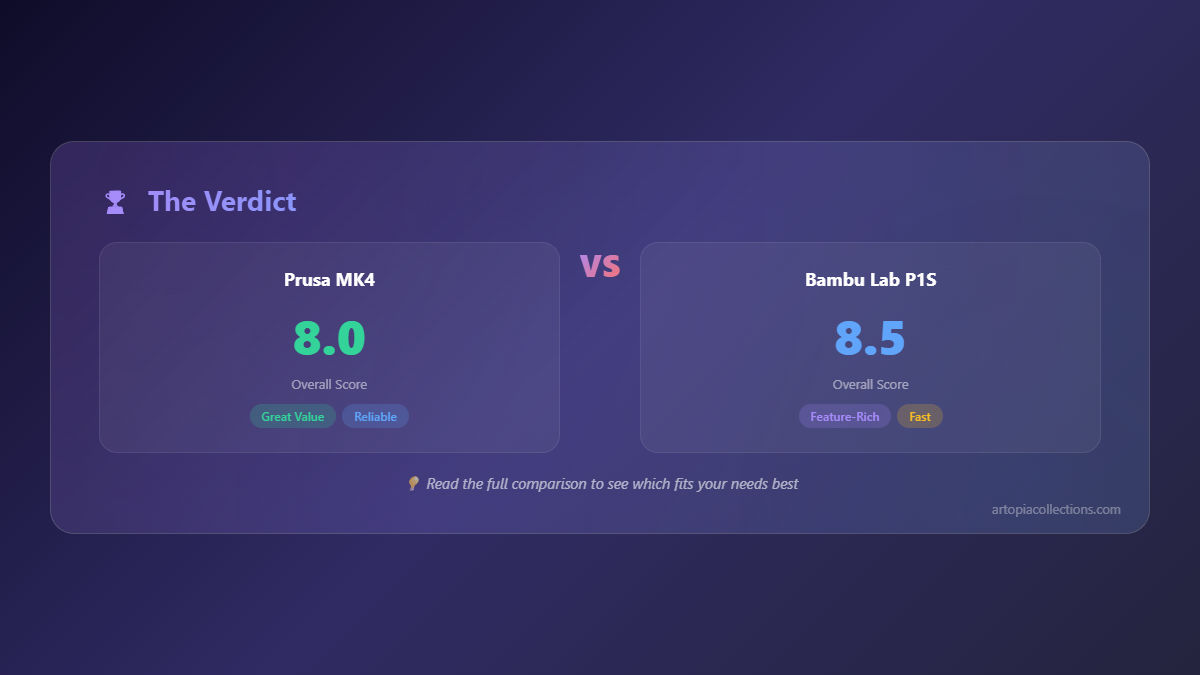
- Proprietary Ecosystem: This is my biggest concern. Bambu Lab is more closed-source. While their software is excellent, you’re largely tied to their ecosystem for parts, firmware updates, and sometimes even specific filaments. This can be restrictive in the long run, especially if parts become difficult to source in India.
- Complexity with AMS: While the AMS is amazing, it adds a layer of complexity. More moving parts mean more potential points of failure, and loading/unloading filaments can sometimes be finicky.
- Price: The P1S itself is fairly competitive, often around ₹80,000 to ₹90,000. But if you add the AMS, which honestly, is half the reason to get a Bambu, you’re looking at ₹110,000 to ₹120,000 easily. Again, you need to factor in shipping and duties.
- Less Focus on Repairability: While not bad, some parts might be harder to replace yourself compared to the Prusa, and documentation for deeper repairs might not be as extensive.
For a business that needs quick turnaround times, multi-color capabilities, and a machine that "just works" with minimal fuss, the Bambu Lab P1S is an absolute beast. We use ours for rapid prototypes, customer-facing models where aesthetics matter, and anything that needs to be done *yesterday*.
The Head-to-Head: My Take as an Indian Business Owner
Alright, let’s get down to brass tacks. Which one is better for *us*, running businesses in India? Here's how I see it:
Speed vs. Consistency
Bambu P1S wins hands down on raw speed. No contest. If your business model relies on churning out parts quickly, the P1S is your guy. But the Prusa MK4, while slower, delivers an almost boringly consistent print every single time. For critical functional parts where failure isn't an option, that consistency is invaluable. And honestly, for a business, fewer failed prints mean less wasted filament (which isn’t cheap, even local brands like FilaCube or RealFil) and less wasted time.
Ease of Use vs. Learning
Bambu is designed for ease. You can basically unbox it and start printing in minutes. Prusa requires a bit more effort upfront, especially if you get the kit, but that effort pays off in deeper understanding. If you're new to 3D printing and want to dive deep, Prusa teaches you. If you just want to print, Bambu delivers.
Ecosystem & Repairability
This is where Prusa really shines for an Indian context. The open-source nature means if a part breaks, you have a better chance of either finding a third-party replacement, printing a temporary one, or repairing it yourself with readily available components. With Bambu, you might be waiting for parts from China, which can add significant downtime. And in business, downtime is lost revenue. For small repairs and maintenance, having a good 3D printer tool kit from Amazon.in is non-negotiable, no matter which printer you choose.
Cost of Ownership
Initial investment is similar, but consider long-term. Prusa's parts might be slightly more expensive individually, but they are often more robust and easier to replace. Bambu's proprietary parts might be harder to source and could involve longer waits. Also, consider filament. Multi-material printing with AMS can use a lot of filament if not managed well, and those Indian filament brands like FilaCube or RealFil, while great, still add up.
Customer Service
Both have good support, but their approaches differ. Prusa's is deeply rooted in community forums and detailed guides, often with direct interaction. Bambu relies more on a ticket system. My personal preference leans towards Prusa's more hands-on, community-driven approach, especially when dealing with complex issues.
So, Which One Should YOU Get for Your Indian Business?
Look, if you run a business like mine, Artopia Collections, where we do a mix of functional prototypes, bespoke artistic pieces, and some rapid manufacturing, the ideal scenario is actually having a bit of both. I know, I know, easy for me to say after years in the game. But hear me out:
- If you're starting out and want to truly understand 3D printing, value long-term reliability, and want to build a foundational business on solid, consistent output: Go with the Prusa MK4. Its reliability will save you headaches, and its open-source nature will teach you invaluable skills.
- If your business model demands speed, multi-color capabilities, and you need a machine that requires minimal tinkering to just get prints out the door: The Bambu Lab P1S (especially with AMS) is an incredible asset. It will drastically cut down your print times and expand your creative possibilities.
- If you can swing it, and your business is growing: A mix of both is the dream setup. Use the Bambu for quick iterations, multi-color projects, and high-volume basic prints. Keep the Prusa for precision, critical functional parts, and when you need that bulletproof reliability. That’s what we’ve gradually moved towards, and it balances the best of both worlds.
Ultimately, the choice comes down to your specific business needs, your budget, and what you prioritize more: the steady, unwavering precision of European engineering, or the blistering speed and convenience of Chinese innovation. Both are fantastic machines, and both can be incredible assets to your 3D printing journey here in India. Just make sure you understand what you're getting into, do your research, and trust your gut. And hey, if you ever want to chat about it more, you know where to find me. Happy printing, everyone!


