Print-on-Demand vs Print-to-Stock: Which 3D Printing Business Model Works Better?
Deciding between print-on-demand (PoD) and print-to-stock for your 3D printing business can significantly impact your operations. This post dives into both models to help you choose the best fit for profitability and growth.

Chai garam, prints chalu! That's usually the vibe in my little workshop, or what I lovingly call my "print farm" (even if it's just two battle-hardened Ender 3s and a newer Creality K1, bless their noisy hearts). You know that feeling, right? That hum of the steppers, the sweet smell of fresh PLA, the anticipation of seeing a digital design slowly, magically, take physical form. That's the stuff dreams are made of for us 3D printing enthusiasts. But turning that passion into a proper business? Ah, that's where things get a bit more... calculating. And today, I really want to talk about something that's probably kept a lot of us awake at night: Should you go for Print-on-Demand (PoD) or Print-to-Stock (PtS)? Which 3D printing business model actually makes more sense, especially here in India?
I've been in this game for a few years now, tinkering, failing, learning, and slowly building up ArtOPIA Collections. And honestly, I've tried both. I've had my moments of starry-eyed optimism, thinking I could just print a mountain of cool stuff and people would flock to buy it. And then I've faced the cold, hard reality of dust-collecting inventory. So, let's break it down, no corporate jargon, just real talk from one maker to another.
The Temptation of Print-to-Stock: Build it, and They Will Come?
Okay, let's start with Print-to-Stock. This is basically the traditional retail model, right? You make a bunch of products, you keep them ready, and when an order comes in, *boom*, it's packed and shipped almost instantly. Sounds fantastic on paper, doesn't it? Imagine a customer clicking "buy" and their item being dispatched within hours. Instant gratification for them, smooth operations for you.
From a production standpoint, it *can* be efficient. If you know you're going to sell 50 pieces of a particular item – say, that super popular articulated dragon everyone loves, or those cute little desk planters – you can batch print them. You set up your machines, load up a big spool of filament, and let them run. You optimize your print settings once, and then just keep hitting print. This can sometimes lead to better overall print times per unit because you're not constantly fiddling with settings or swapping models. And if you have multiple printers, you can really churn things out. For example, if I wanted to stock 20 small Ganesh idol models, I could dedicate my Ender 3s for a couple of days and have them ready.
But here's the deal, especially for us small businesses, the one-man army (or two-man army, if you count my cat supervising). The biggest, most terrifying word in Print-to-Stock is: INVENTORY. That's where the dream often crumbles. Every single item you print and put on a shelf, hoping it will sell, represents tied-up cash. Think about it. A good quality PLA filament like eSun or Overture can cost you anywhere from ₹1000 to ₹2000 for a 1kg spool, right? (Speaking of which, if you're looking for reliable PLA, check out options on Amazon.in here – I usually buy mine in bulk when there are sales!).
Now, if that 1kg spool makes, say, 20 small items, and you print all 20, but only 5 sell, you've got 15 pieces just sitting there. That's a good chunk of your capital (and electricity cost!) just gathering dust. And what if trends change? Remember when fidget spinners were all the rage? Imagine stocking up on those and then suddenly, crickets. Your stock becomes obsolete, or at best, a very slow seller. I personally ended up with a box full of very specific-sized phone stands that hardly anyone bought after a while because, well, phone sizes changed! It was a painful, expensive lesson. Storage space is another thing – my apartment isn't getting any bigger, you know?
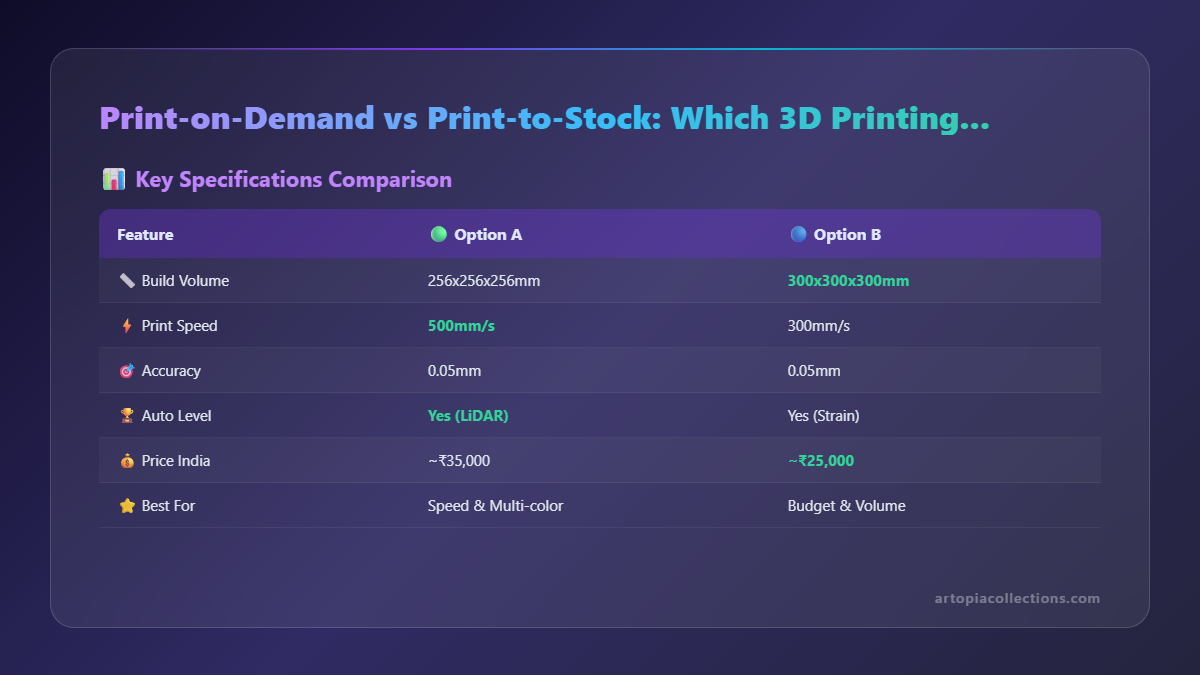
So, Print-to-Stock, while offering faster fulfillment, comes with significant financial risk and logistical headaches for a small 3D printing business. It demands excellent market prediction, which, let's be honest, is practically impossible for most of us. You need deep pockets and a strong stomach for risk.
Print-on-Demand: The Lean, Mean, Printing Machine
Now, let's swing to the other side: Print-on-Demand. This is exactly what it sounds like. Someone places an order, and *then* you start printing. It's like having a custom tailor for every single customer. And honestly, this is mostly where my business operates now, after a few hard lessons.
The number one, absolute biggest benefit of Print-on-Demand is this: ZERO INVENTORY RISK. Let that sink in. You only print what's already sold. This is a game-changer for cash flow. When an order comes in, the money often comes with it (or soon after), and *then* you use that money to cover your filament costs and electricity. It's incredibly capital-efficient. You're not tying up thousands of rupees in potential dust collectors.
Another massive advantage is the ability to offer incredible customization. Since you're printing fresh anyway, changing a color, adjusting a size slightly, adding a name, or making a small design tweak is super easy. This opens up so many possibilities for niche markets and personalized products, which customers absolutely love. Think about custom lithophanes – those beautiful photo lamps. I can't print those to stock; every single one is unique. But with PoD, I can offer them with confidence. It allows for a much wider product catalog without commitment.
And let's not forget the quality aspect. When you print on demand, each item is fresh off the print bed. You're constantly monitoring your machines, refreshing your designs, and ensuring the latest, best version goes out. There's a certain charm to knowing something was made *just for you* a day or two ago, you know?
But it's not all sunshine and rainbows. PoD has its own set of challenges, and the biggest one is lead time. In today's Amazon Prime-fueled world, customers expect things yesterday. Telling them, "Hey, your order will ship in 3-5 business days because I need to print it first," can be a tough pill to swallow for some. You need to be super transparent about your production and shipping times. Clear communication on your product pages and during checkout is absolutely critical. I always put my estimated print and dispatch times right there.
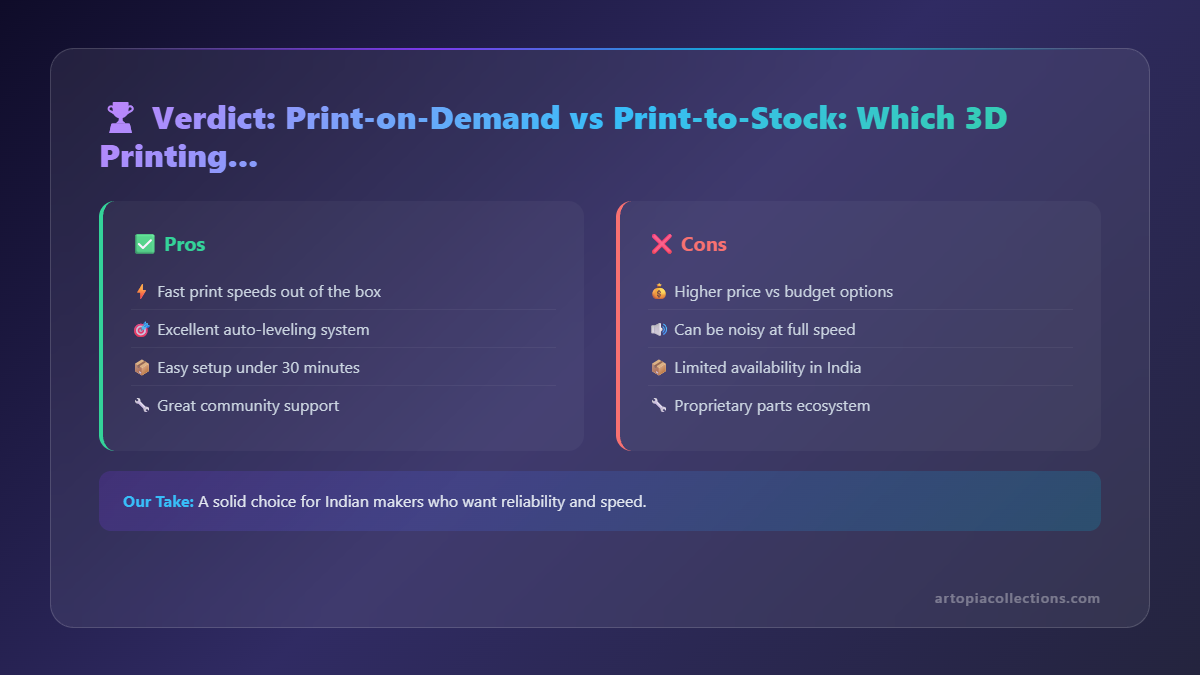
Then there's the question of machine reliability and scalability. If you only have one or two printers, and suddenly you get a rush of orders, or worse, one of your workhorse machines like my Ender 3 V2 decides to throw a fit (clogged nozzle, bed leveling issues – we've all been there, right?), your orders can quickly pile up. It can be stressful. You really need to invest in good quality machines, maintain them religiously, and maybe have a backup plan. I've even considered getting a slightly faster CoreXY printer like the Creality K1 (which I eventually did get) just to handle quicker prints for PoD, but that's another investment to consider. If you're looking for accessories or even a first printer, check out some options on Amazon.in. Getting the right tools makes a huge difference!
The Hybrid Approach: My Sweet Spot (For Now!)
So, after wrestling with both models, making mistakes, and learning from them, I've landed on what I like to call the "Hybrid Approach." It's not perfect, but it's what works best for ArtOPIA Collections right now, balancing risk with customer satisfaction.
Here's how I do it:
- Core Bestsellers - Small Stock: For items that I *know* sell consistently well, week after week, I'll keep a very small, manageable stock. Maybe 5-10 units. For example, a popular keychain design, or certain small, multi-functional desk organizers. These are items that are relatively quick to print (under 2-3 hours) and have a proven track record. This allows me to ship these immediately when an order comes in, satisfying those impatient customers and getting good reviews for speed. The risk here is minimal because they *will* sell eventually. I might spend ₹500 on filament to print 10 keychains, knowing they'll be gone in a week or two.
- Everything Else - Pure Print-on-Demand: All custom orders, personalized items, larger prints (like those intricate cosplay props that take 20+ hours), or anything that's a newer, untested design? Those are strictly Print-on-Demand. I won't print them until the order is confirmed. This keeps my inventory lean and my cash flow healthy.
- Strategic Batching: Even for PoD items, if I get multiple orders for the *same* item (or similar items that use the same filament color), I'll batch them together. This is where having multiple printers helps. I can set up both my Enders to print two different client orders at the same time, maximizing efficiency.
This hybrid model gives me the best of both worlds. I can offer quick shipping on my most popular items, which builds trust and gets those immediate sales. At the same time, I avoid the crippling inventory risk for the vast majority of my product catalog, allowing me to be more creative and flexible with my offerings. It's a constant balancing act, monitoring what sells, what's trending, and what needs a fresh approach.
Considering the Indian Context
Running a 3D printing business in India also has its unique flavor. Here are a few things I always keep in mind:
- Filament Sourcing: As I mentioned, PLA is king. Brands like eSun, Overture, Creality, and local Indian brands are readily available. I'm always on the lookout for good deals, especially on 1kg spools, because filament cost is a significant operational expense.
- Electricity Costs: Printers run for hours. While an individual print might not cost much in electricity, it adds up over days and weeks. Factor this into your pricing! Don't just consider filament.
- Shipping Logistics: India's logistics network has improved dramatically, but lead times for shipping can still vary. Whether it's India Post, Delhivery, or Bluedart, I always factor in transit time. For PoD, this means the customer's total wait time includes both print time *and* shipping time.
- Customer Value Perception: Indian customers appreciate good value and often look for uniqueness. Personalized 3D prints really hit that sweet spot. But they also expect good quality for their money.
- Niche is Nice: The 3D printing market is growing here, so finding your niche is important. Don't try to print everything. Focus on what you're good at, what your customers love, and what you can deliver consistently.
So, Which Model Works Better?
Honestly? For a small, passionate 3D printing business like mine, especially when starting out, Print-on-Demand is the safer, more sustainable path. It minimizes financial risk, frees up your capital, and allows you to be incredibly flexible with your product offerings. It teaches you discipline in managing customer expectations and optimizing your production process.
As you grow, as you understand your market deeply, and as you build a track record of consistent sales for specific items, *then* you can strategically introduce a small Print-to-Stock component for your absolute bestsellers. Think of it as evolving from a lean startup to a slightly more established player, but always with caution.
The biggest takeaway is this: Don't chase trends with large stock investments. Let your customers tell you what they want by placing orders. Use PoD to test the waters, build your reputation, and then, if the data supports it, dip your toes into stocking a few proven winners. It's a journey, right? And every print, every order, every happy customer (and even every failed print!) is a step on that journey. Keep printing, keep learning, and most importantly, keep that passion alive!


