Amazon Handmade vs Regular Amazon: Which Is Better for 3D Printed Products?
Deciding where to sell your 3D printed items on Amazon? This post breaks down the differences between Amazon Handmade and the regular marketplace, comparing fees, audience, and branding to help you choose.

Amazon Handmade vs Regular Amazon: Which Is Better for 3D Printed Products? A Desi Creator's Take!
Man, running a small 3D printing business here in India, it's a constant juggle, isn't it? One day you're tweaking settings on your Creality Ender 3 V3 SE trying to nail that perfect first layer for a custom order, the next you're staring at your laptop screen, head scratching, wondering where the heck is the best place to actually SELL all this cool stuff you're making! I mean, we pour our heart and soul into designing, printing, post-processing... but if no one sees it, what's the point, right? And for ages, this question has haunted me, especially when it comes to the big daddy of online retail: Amazon. But not just "Amazon," no. We're talking about the two beasts: Regular Amazon vs. Amazon Handmade. Which one's going to give my little venture, Artopia Collections, the best shot? Let's dive in, because I've spent way too many late nights pondering this, and hopefully, my ramblings save you some!
The Eternal Amazon Dilemma: Where Do My Prints Belong?
So, here's the deal: Amazon is HUGE. Like, undeniably massive. Everyone and their uncle shops on Amazon.in. And that reach? It's seductive. For any small business, especially one in a niche like 3D printing, getting your products in front of that many eyeballs is the ultimate dream. But, and it's a big BUT, it's also a double-edged sword. You're competing with literally millions of products, from big brands to other small sellers like us, often selling mass-produced, injection-molded plastic stuff for dirt cheap. That's where the idea of Amazon Handmade comes in, right? It promises a more curated space, a sanctuary for makers. But is it really that simple? Let's break it down, based on my experience and what I've learned navigating the Indian e-commerce landscape.
Regular Amazon: The Wild West of 3D Prints
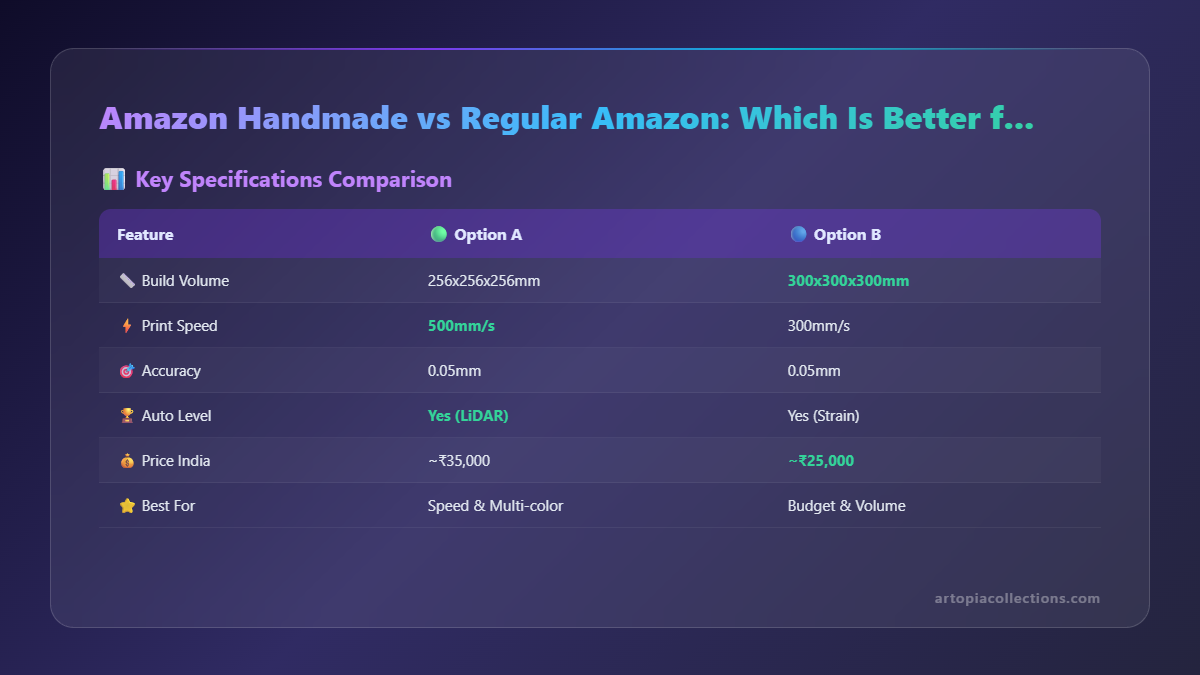 Okay, so let's talk about Regular Amazon first. This is where most people instinctively think of selling. You sign up as a seller, list your product, and boom, you're live. Or so you hope.
Pros of Regular Amazon for 3D Prints:
- Sheer Volume & Reach: This is the undeniable king. Millions of daily visitors mean a higher chance someone will stumble upon your unique 3D printed coasters or that cool articulated dragon you spent hours perfecting.
- FBA (Fulfilled By Amazon) Convenience: Honestly, FBA is a godsend for small businesses if you can manage the costs. You send your inventory to Amazon's warehouse, and they handle the storage, packing, shipping, and even customer service for eligible items. It frees up so much of my time that I can spend more on actually designing and printing! Imagine not having to run to the post office every day. It's a huge relief, especially when you're a one or two-person show.
- Lower Barrier to Entry: Getting started on regular Amazon is relatively straightforward. You don't need a special application process like Handmade. Just register, list, and you're good to go.
- SEO Power: Amazon's search algorithm is powerful. If you do your keyword research right and optimize your listings, you can rank pretty well for specific terms, bringing in organic traffic.
Cons of Regular Amazon for 3D Prints:
- Brutal Competition: This is the biggest killer. You're not just competing with other 3D printers, but with every other manufacturer of similar items. For example, if I'm selling a 3D printed vase, I'm up against ceramic, glass, and mass-produced plastic vases that might be cheaper simply due to scale.
- Pricing Pressure: Because of the competition, there's immense pressure to lower your prices. This often means compromising on your profit margins, which for a custom-made, time-intensive 3D print, is just heartbreaking. A complex print can take 8-10 hours, plus post-processing. You can't price it like something that rolled off an assembly line in seconds.
- Generic Feel & Branding Challenges: Your product gets lost in the sea of listings. It's hard to convey the "handmade" story, the passion, the uniqueness of a 3D print when it's just another SKU next to a million others. Your brand identity often takes a backseat.
- Fees, Fees, Fees: Oh, the fees! Amazon has referral fees (a percentage of your sale, typically ranging from 5% to 15% for categories our stuff might fit into like Home & Kitchen, or even up to 18% for certain electronics accessories), closing fees (small fixed fees, sometimes ₹5, sometimes ₹40 depending on price slab), and then if you use FBA, there are storage fees, pick-and-pack fees, weight handling fees. It adds up, really fast. Selling a small item for ₹200 might leave you with barely ₹50 after all deductions. You have to factor this into your pricing from the very beginning.
- IP & Design Protection: This is a big one for makers. If you've designed something truly unique, putting it on Regular Amazon means it's out there for anyone to see and potentially copy. It's harder to protect your original designs when you're just another product listing.
So yeah, Regular Amazon is like this huge bazaar. Great if you have mass-market appeal or a truly disruptive price point, but it can be a tough grind for unique, handcrafted (or rather, machine-crafted with love) items.
Amazon Handmade: The Artisan's Corner?
Now, let's swing over to Amazon Handmade. This launched in India a few years ago, and I, like many other crafters, was pretty excited about it. The promise was a curated marketplace for genuinely handmade products, a place where artisans could shine.
Pros of Amazon Handmade for 3D Prints:
- Exclusivity & "Handmade" Credibility: This is the main draw. Being listed under "Handmade" immediately signals to customers that your product is special, not mass-produced. It elevates your item. For 3D prints, where each piece is often individually made (even if by a machine), this is a huge benefit. It helps justify a higher price point.
- Less Competition (and Better Competition): The competition isn't as cutthroat as Regular Amazon. You're mostly competing with other artisans, not giant factories. This means customers coming to Handmade are often looking for unique, quality items, and they're usually willing to pay a premium for that.
- Better Branding Opportunities: Handmade offers more flexibility for telling your brand's story. You can have a dedicated artisan profile, share your process, and really connect with your customers. This is crucial for small businesses like mine, Artopia Collections, where every piece has a story behind it.
- No Monthly Professional Selling Fee (Often): For a long time, Amazon Handmade waived the professional selling fee (which is typically ₹499 + GST per month for Regular Amazon if you're selling more than 40 units). This was a huge advantage for new sellers, though it's always good to check current terms. You still pay referral fees, but the waiver of the monthly fee can be a significant saving initially.
- Targeted Audience: People browsing Amazon Handmade are specifically looking for unique, often personalised, items. This means higher intent and a better conversion rate if your product fits their needs.
Cons of Amazon Handmade for 3D Prints:
- Application Process: It's not an open door. You have to apply and prove that your items are genuinely handmade (or "hand-altered" or "hand-assembled" which 3D printing often falls under). They want to see your process, your workshop, and understand how you create. This can be a bit of a hurdle, but it's also what keeps the quality high.
- Limited Reach (Potentially): While the audience is targeted, the sheer volume of traffic isn't as high as the main Amazon marketplace. Your products might not get as many initial eyeballs, meaning you might need to do more external marketing.
- Category Restrictions: Handmade has specific categories. Sometimes fitting a 3D printed product into these can be tricky. Is a 3D printed planter "Home Decor"? Is a 3D printed phone stand "Electronics"? It takes a bit of thought and the right category choice.
- Still Amazon Fees: While the monthly fee might be waived, you still pay referral fees on sales, just like Regular Amazon. So, don't think it's a completely free ride once you make a sale.
- Debate: Is 3D Printing "Handmade"? This is the philosophical debate. My good quality PLA filament goes into a machine, not my hands directly. But I designed it, I prepped the file, I calibrated the printer, I monitored the print, and I hand-finished it. Is that enough? Amazon Handmade says yes, provided you meet their criteria. It's about the creative process and the individual craftsmanship, not just literal hand-touching of every molecule.
The Verdict for Artopia Collections: My Personal Take
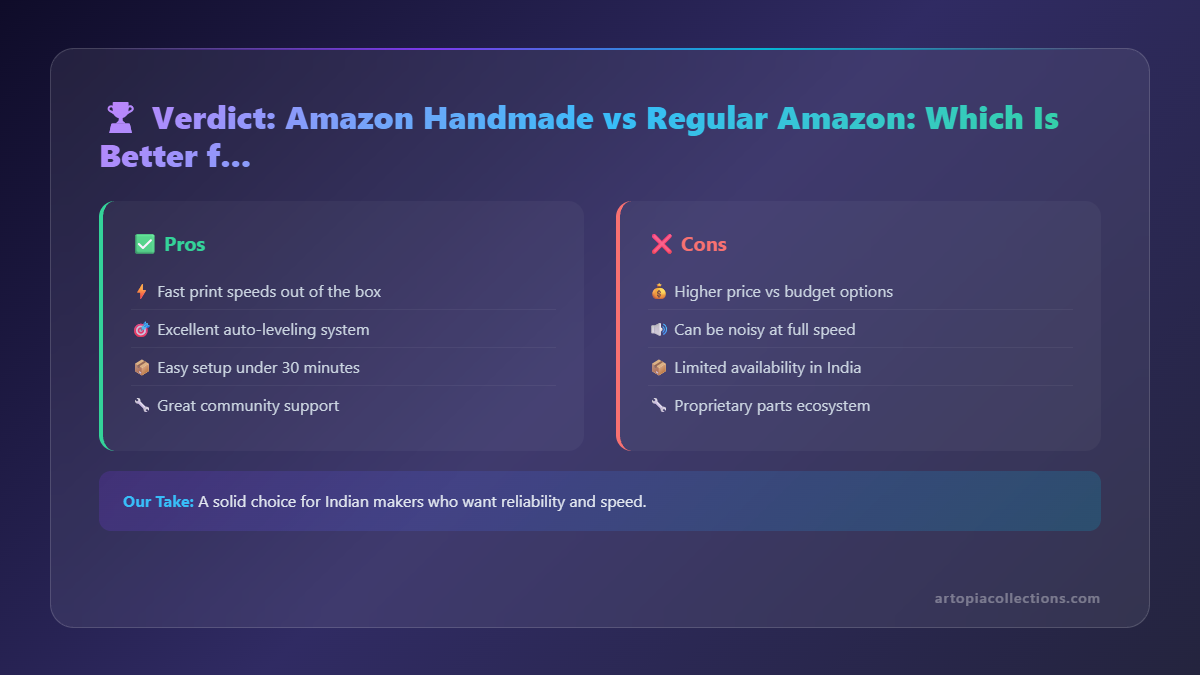 So, which one is better for 3D printed products here in India? Honestly, after juggling my prints on different platforms, for a business like Artopia Collections that focuses on unique, often custom-made, and thoughtfully designed 3D prints, **Amazon Handmade is generally the better fit.**
Here’s why I lean that way:
- Justifying the Price: My prints, like a multi-color articulated dragon or a detailed architectural model, take time. A lot of time. And good filament isn't exactly cheap, especially when you're importing specific types or colours. I'm not using some ultra-cheap ₹500/kg filament (though I do keep some around for prototypes, ha!). I invest in quality, often from brands like eSUN or Overture, which can run ₹1500-₹2000 per kg. So, I need to command a price that reflects the design, the print time, the material, and the post-processing. Handmade customers understand and appreciate that value. Regular Amazon customers, often just looking for the cheapest option, rarely do.
- Standing Out: On Regular Amazon, my unique items just get lost. It's like shouting into a hurricane. On Handmade, even though the overall volume might be lower, my voice feels heard. My products get the spotlight they deserve, away from the mass-produced clutter.
- Storytelling: I love sharing the journey of a print – from the initial 3D model on Fusion 360 to the final product. Handmade allows me to convey that passion, which resonates with buyers looking for something with a soul.
- Less Headache with IP: While not foolproof anywhere, the curated nature of Handmade generally means a slightly more respectful environment for unique designs.
That said, it's not a complete dismissal of Regular Amazon. For certain types of 3D printed products – say, generic, utilitarian printer parts, or very simple, inexpensive items like cable clips that can be mass-produced quickly on a farm of Anycubic Kobra Go printers – Regular Amazon could still make sense, especially if you can get volume up and leverage FBA effectively. But for creative, artistic, or custom pieces, I just don't think it's the right battleground for us makers.
A Hybrid Approach? Maybe.
Could you use both? In theory, yes. You could list your more generic, utility-focused 3D prints on Regular Amazon, and your truly unique, artistic, or custom pieces on Handmade. The challenge here is managing two separate storefronts, two inventory systems (even if both are Amazon), and maintaining brand consistency. For a small operation, it might just be too much to handle. I personally prefer to focus my energy where I get the most value for my unique creations.
One thing I will say, regardless of which platform you choose, presentation is EVERYTHING. Good product photography, clear, detailed descriptions, and transparent communication about your process and materials (like which specific eSUN PLA+ filament you used, or if it's PETG for durability) will make a world of difference. Your customers want to know what they're getting and why it's worth their hard-earned rupees.
Final Thoughts from a Fellow Maker
Look, the journey of an independent creator in India is full of twists and turns. From getting reliable power for our printers (seriously, sometimes the power cuts just kill a 20-hour print, and my heart just sinks!) to sourcing quality filament at a reasonable price, it's a grind. But the joy of seeing someone appreciate something you made, something that started as an idea in your head and became a physical object thanks to your printer – that's what keeps us going.
So, for my fellow 3D printing enthusiasts looking to sell, my advice is this: If your product is unique, if it tells a story, if it requires craftsmanship and attention to detail, invest your time and energy into Amazon Handmade. It's not a magic bullet, no platform ever is, but it gives your work the respect and visibility it deserves. If you're selling simpler, more utilitarian prints where volume and competitive pricing are key, then Regular Amazon might still be your go-to. But for me, the heart of Artopia Collections beats strongest in a place that values the "making" as much as the "selling."
What are your thoughts? Have you tried selling 3D prints on either platform? Drop a comment below, I'd love to hear your experiences!


