3D Scanning Pet Paws for Custom Keepsake Prints
Discover how 3D scanning offers a unique way to capture your pet's paw prints in intricate detail. Turn these digital models into beautiful, custom keepsake prints that you'll cherish forever.
Artopia Collections Blog Team12 May 20269 min read

The Paw-some Truth: Why 3D Scanning Your Pet's Paws is the Sweetest Keepsake You Never Knew You Needed
Remember that day your little furball first scampered into your life? That tiny, clumsy creature who instantly stole a chunk of your heart and decided to live there rent-free, probably shedding a little hair along the way. Yeah, that feeling. It's pure magic, isn't it? And honestly, as a passionate 3D printing enthusiast and owner of a small business right here in India, ArtOPIA Collections, I've seen a lot of things get 3D printed. From intricate architectural models to super cool gaming props, I've done it all. But here's the deal, nothing, and I mean absolutely nothing, gets me quite as choked up as the custom pet paw prints we get to create for people. It's not just a print; it's a tangible piece of a love story, a memory you can hold in your hand forever. It's basically bottling up pure joy, you know?From Humble Beginnings: How I Fell for the Furry Footprints
So, how did I even get into this niche? Well, it started pretty organically, as most good things do. I'd been running ArtOPIA for a couple of years, mostly doing industrial prototypes and some decorative art pieces. My main workhorse at the time was (and still often is, for reliability!) a couple of souped-up Creality Ender 3 S1 Pro units. Great machines, honestly. You can find them on Amazon easily, though prices fluctuate, they're generally around ₹35,000-₹45,000 these days depending on offers – check out the Creality Ender 3 S1 Pro here if you're curious! Anyway, a friend of mine, a real dog person, lost his beloved Golden Retriever, Buddy. He was absolutely heartbroken. He came to me, not for a print, but for advice. He had a clay imprint of Buddy's paw, but it was old and starting to crumble. He just wanted to preserve it somehow. And that's when it hit me. Why not 3D scan it? I had a decent handheld 3D scanner, nothing super fancy like an Artec, but good enough. I scanned the clay impression, cleaned it up in software (which, trust me, was a labour of love – old clay isn't the cleanest surface!), and then printed it. When I handed him the finished, solid, stone-like print, his eyes welled up. He told me it felt like he had a piece of Buddy back. That moment? That's when I knew this wasn't just another printing service. This was something special.More Than Just a Print: The Emotional Value
In India, our pets are family. Whether it's a pampered Persian cat, a street dog adopted into a loving home, or a lively Labrador, they're our children, our confidantes, our best friends. They give us so much joy, loyalty, and unconditional love. But their time with us, tragically, is often far too short. And that's where 3D scanning comes in. It's not just about getting a cool 3D model; it's about capturing a moment, a unique identifier of your beloved companion. Imagine this: You have a little sculpture, a relief, or even a detailed tile of your pet's paw print. It’s not just a picture; it’s tactile. You can feel the little pads, the texture of their skin, the unique contours. It’s a permanent, beautiful tribute. I personally think it's one of the most thoughtful gifts you can give someone who loves their pet, or even a truly heartwarming way to remember a pet who has crossed the rainbow bridge. It's a way to keep their memory vibrant and pre
The Nitty-Gritty: How We Make Paw-some Memories Happen
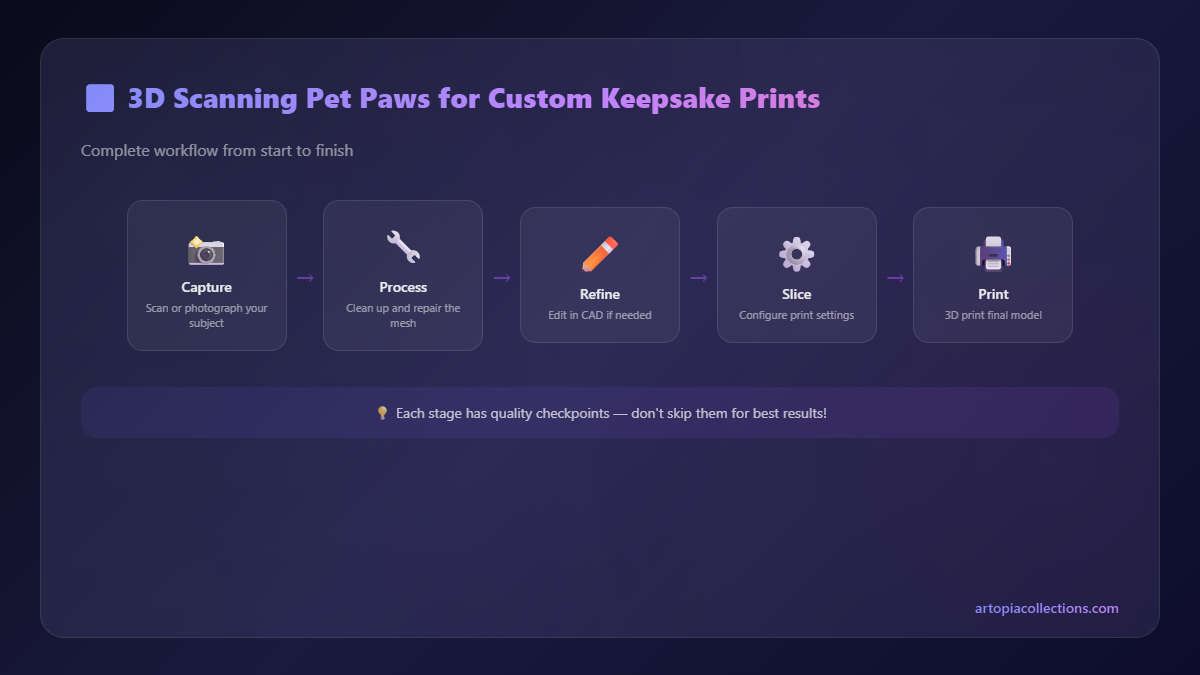
Okay, so enough with the emotional stuff, let's talk about the tech and the process! Basically, it breaks down into three main stages: Scanning, Digital Clean-up, and 3D Printing.Stage 1: The Scan – Where the Magic Begins (and sometimes, the Wiggles)
This is perhaps the most critical, and often, the most challenging part, especially if we're scanning a live, energetic pet! * For a Live Pet: The thing is, pets don't always understand the concept of "stay still for science." We use a high-resolution, handheld 3D scanner that's safe and non-invasive. We aim for quick, multiple passes to capture the paw from various angles. Patience is key here, and often, a lot of treats! We usually work with the pet parent to hold the paw gently but firmly. The goal is to get enough data points to reconstruct the paw accurately. Honestly, a super wiggly puppy can make this a real adventure, but we always get there. Sometimes, for very skittish animals, we might suggest doing a traditional clay impression first, which we then scan. It’s all about what works best for the pet and ensures a quality result. * From an Existing Impression: This is much easier, though it comes with its own quirks. If you have an old clay, plaster, or ink impression, we can scan that directly. The challenge here is often the quality of the original impression – sometimes they're smudged, cracked, or simply not very deep. But hey, that's what digital clean-up is for!Stage 2: Digital Clean-up – Making Sense of the Mess
Once we have the raw scan data, it's basically a cloud of points or a mesh that looks a bit like a ghost of a paw. This data needs serious love in specialized 3D software. * We align the scans, merge them, and then start removing any digital "noise" – stray points, hair, or parts of the ground that might have been accidentally scanned. * Then comes the real artistry: "healing" the mesh. This involves filling any tiny holes, smoothing out rough patches without losing the important details, and ensuring the surface is ready for printing. If the original impression was shallow, we might need to digitally enhance some of the paw pad definitions to make them pop more. This part can take anywhere from an hour to several hours, depending on the complexity and quality of the initial scan. This is where experience really pays off, making sure the final model is a faithful, yet perfected, representation.Stage 3: 3D Printing – Bringing it to Life
This is my favorite part, watching the digital model slowly become a physical object! * Material Choice: For keepsakes, I generally recommend good quality PLA filament. It's durable, easy to print with, and comes in a huge array of colours. But we also offer special filaments: * Wood-fill PLA: Gives a beautiful, natural wood texture and can even be sanded and stained! It smells faintly of wood while printing, which is cool. * Stone-fill PLA: Imparts a hefty, textured feel, resembling granite or marble. It's fantastic for a more monumental, timeless look. * Silk PLA: For a shimmery, elegant finish that catches the light beautifully. * Print Settings