3D Scanning for Jewelry Design: Digitizing Existing Pieces for Reproduction
Discover how 3D scanning revolutionizes jewelry design by providing precise digital models of existing pieces. This technology empowers jewelers to easily reproduce, scale, or modify intricate designs for new creations.

Lost an Earring? Got a Cherished Piece You Want Replicated? Let's Talk 3D Scanning!
You know that feeling, right? That gut-wrenching moment when you realize one of your grandmother's antique jhumkas, a piece passed down through generations, is gone. Or maybe you've got this absolutely stunning pendant, intricate beyond belief, and you wish you had another one, or maybe even a smaller version for your daughter. For years, this kind of thing meant painstakingly finding a skilled artisan, hoping they could replicate the design by hand – a process that's not only incredibly expensive but also, let's be honest, often falls short of capturing every tiny, perfect detail. Well, my friends, that's where my world, the incredible universe of 3D printing and now, 3D scanning, comes in. I'm telling you, it’s a total game-changer, especially for us here in India with our rich heritage of breathtaking, detailed jewelry.
The Heartbreak of the Hand-Me-Down
Look, I've heard countless stories. A wedding ring gets damaged beyond repair. A beloved necklace clasp breaks, and in trying to fix it, a tiny, unique filigree element is lost. Or perhaps, most commonly, one earring goes missing. It's almost a rite of passage for us, isn't it? The other half just sits there, beautiful but incomplete, a constant reminder of what was lost. Traditionally, you'd take the remaining piece to a local goldsmith. They’d try their best, sketching, measuring, maybe even taking an impression if they're really old school. But reproducing intricate Indian jewelry – think delicate Kundan work, fine Meenakari patterns, or even just complex filigree – by hand is a monumental task. It requires an artist with decades of experience, and even then, human hands can introduce subtle variations. It's never truly a *perfect* reproduction. And honestly, finding someone with that level of skill and patience in today's fast-paced world? That's a challenge in itself, forget about the cost, which can run into thousands, sometimes even lakhs, just for the modeling.
My Secret Weapon: 3D Scanning!
 So, what if I told you there's a way to capture every single curve, every delicate engraving, every microscopic detail of that existing piece of jewelry, with absolute digital precision? A way to turn a physical object into a digital blueprint that can then be manipulated, resized, reproduced, and printed endlessly? That, my friends, is the magic of 3D scanning. It's not just for big industrial parts or archaeological digs anymore. It's for your grandma's earring, it's for that intricate temple pendant, it's for anything you hold dear that needs a digital twin.
Basically, a 3D scanner works by shining light (or sometimes using lasers) onto an object and measuring the distance from the scanner to points on the object's surface. It collects millions of these points, creating what we call a "point cloud." This cloud then gets stitched together and converted into a mesh, a digital 3D model. Imagine taking a gazillion super-accurate measurements all at once, in a fraction of the time it would take a human. That's essentially what's happening. And the accuracy? We're talking microns here, folks. Millimeter-perfect isn't good enough for jewelry; we need micron-level precision, and modern scanners are delivering that.
Why Jewelry and 3D Scanning Are a Match Made in Heaven
Jewelry is, by its very nature, intricate. It's often small, highly detailed, and can have complex geometries that are a nightmare to model from scratch in CAD software without a physical reference. This is where 3D scanning truly shines. Instead of spending hours or days trying to recreate a flowing floral pattern or a delicate filigree loop in a CAD program like Fusion 360 or MatrixGold (which, by the way, are amazing tools, but they need a starting point!), you simply scan the existing piece. And poof! You have your starting point, a perfectly accurate digital representation.
And let's not forget the sheer variety of textures and finishes in Indian jewelry. Polished gold, matte silver, carved wood, embedded stones – a good scanner can handle it all, capturing the form, not just the surface color. It opens up so many possibilities:
- Reproduction: The obvious one. Lost an earring? Scan the other, print a new pair. Simple.
- Scaling: Love a pendant but wish it was smaller for a child, or larger as a statement piece? Scan it, scale it in software, print it.
- Customization: Take an element from one piece, scan it, and integrate it into a completely new design. Mix and match heirloom patterns with modern aesthetics.
- Archiving: Digitally preserve precious family heirlooms. Even if the physical piece is lost or damaged, its digital twin lives on.
- Prototyping: Scan a handmade wax model, refine it in CAD, and then print a perfect master for casting.
My Journey: From Hobbyist to Jewelry Digitizer (and a Few Bumps Along the Way)
 When I started Artopia, my little 3D printing business here in India, I was mostly focused on FDM prints – cool prototypes, functional parts, custom gifts. But the jewelry aspect always fascinated me. The precision, the artistic flair, the cultural significance. I quickly realized that while I could print amazing things on my Creality Halot-One or my Anycubic Photon Mono X, getting the original design from a physical piece into a digital file was the biggest hurdle for jewelers and individuals. Manual CAD modeling for super intricate stuff? Forget it, it’s a nightmare. That's when I dove headfirst into 3D scanning.
I started with photogrammetry, which is basically taking a gazillion photos from all angles and stitching them together with software. It's cheap to get into (just need a good camera and a turntable!), but for tiny, reflective, highly detailed jewelry, it was a pain. Reflective surfaces are a scanner's nemesis, yaar! And getting enough overlap without blur for such small objects was tough. It worked for some things, but not consistently for the kind of precision jewelry demands.
So, I invested. And honestly, it was one of the best decisions for my business. I currently use a structured light desktop scanner for most jewelry pieces. Why structured light? Because it projects patterns of light (like stripes or grids) onto the object and analyzes the distortion of these patterns to calculate the 3D shape. This method is incredibly accurate, typically within tens of microns, which is essential for jewelry. Handheld scanners like the Revopoint POP 3 (which is pretty cool for larger objects, and you can get one for around ₹50,000-₹70,000 on Amazon if you're looking to get started, check it out here), are great, but for jewelry, a dedicated desktop structured light scanner gives you that consistent, high-res detail you desperately need.
My Process: From Sparkle to Scan to Sterling (or whatever metal you fancy!)
- Prep is Key: This is crucial. Jewelry is often shiny, and reflections mess with scanners. Sometimes I use a temporary matte spray (which washes off easily without damage) to dull the surface. For very intricate pieces, I might also use a fine powder application to help capture details.
- The Scan Session: The piece is placed on a rotating turntable. The scanner takes multiple passes, capturing data from all angles. My software then automatically stitches these individual scans together. It's mesmerizing to watch the digital model build up in real-time on the screen. For a small ring, this might take 5-10 minutes. For a really complex, multi-sided pendant, maybe 20-30 minutes, sometimes more if it needs repositioning.
- Post-Processing & Cleanup: Once the raw scan data (the point cloud and initial mesh) is captured, it's never perfect. There might be some noise, stray points, or tiny holes where the scanner couldn't quite see. This is where the magic of software like Geomagic Wrap or Meshmixer comes in. I spend time cleaning up the mesh, filling holes, smoothing surfaces without losing detail, and ensuring it's a "watertight" model – meaning it's a solid, printable object without gaps. This step can take anywhere from an hour to several hours, depending on the complexity and quality of the initial scan.
- Refinement (CAD): Sometimes, a scan is just the starting point. If a client wants to add a new gem setting, engrave something, or modify an existing feature, I'll take the cleaned scan model into a CAD program. This is where true design flexibility comes in.
- 3D Printing the Master: Once the digital model is perfect, it's time to print. For jewelry, we almost exclusively use resin printers. FDM printers, like an Ender 3, are fantastic for prototyping larger models, but their layer lines are too visible for the intricate details of jewelry. Resin printers, like my Halot-One or Photon Mono X, use UV light to cure liquid resin layer by layer, achieving incredible precision and smooth surfaces. We use specialized "castable" resins that are designed to burn out cleanly in a jeweler's kiln, leaving no ash residue. This is vital for the next step.
- Casting: The printed resin model (the "master pattern") is then sent to a professional jeweler or casting house. They embed it in a plaster-like material, burn out the resin in a high-temperature oven (lost wax casting method), and then pour molten metal (gold, silver, platinum, brass) into the cavity. Once cooled, the plaster is broken away, and voila! A perfectly replicated metal piece, ready for finishing and polishing.
Cost Considerations: What to Expect in India
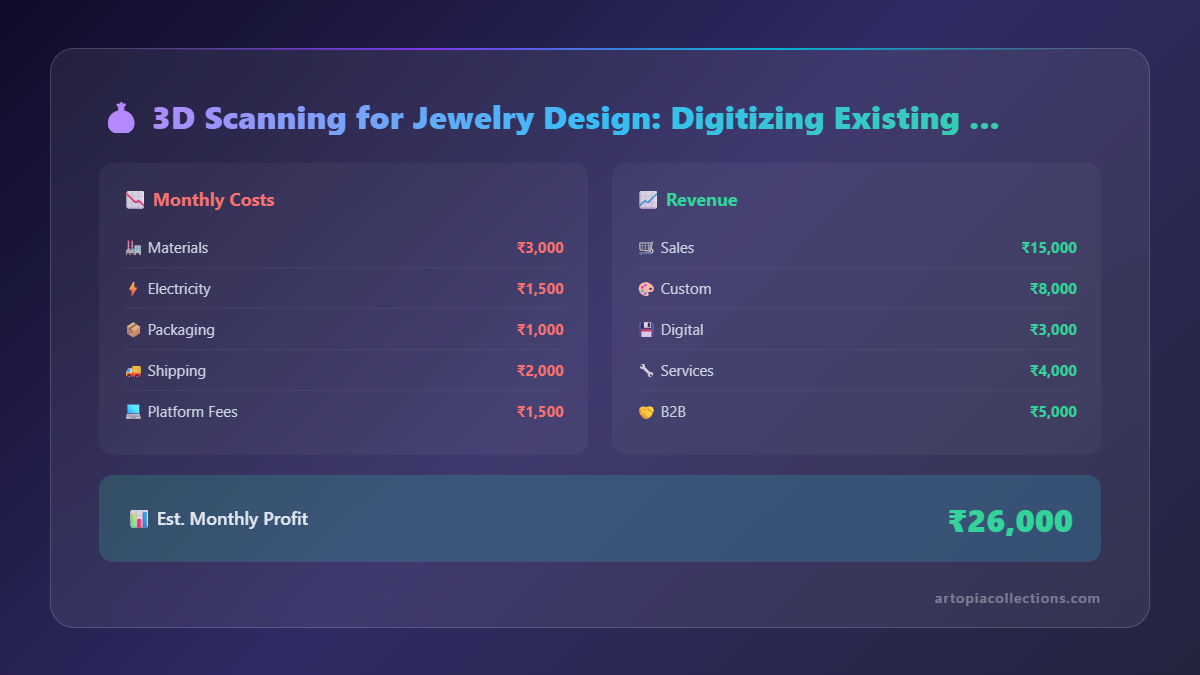
Alright, let's talk numbers, because that's always important. Getting a piece 3D scanned and reproduced isn't pocket change, but it's often far more cost-effective and precise than traditional hand-replication methods for complex items.
- Scanning Service: For a single, intricate jewelry piece (like a ring or a pendant), my scanning and initial cleanup services typically range from ₹3,000 to ₹8,000, depending on the complexity and size. If you need extensive CAD refinement or design modifications after the scan, that's additional, usually charged hourly.
- 3D Printing (Resin): Printing the castable resin master pattern depends on the volume of resin used. Castable resins are pricier than standard resins. Expect to pay anywhere from ₹500 to ₹2,500+ for the printed model, again, depending on its size and intricacy. A typical ring might be around ₹700-₹1200 for the print. You can find good quality castable resins on Amazon, though professional jewelers often use specific brands not always consumer-grade. For general prototyping resins, you can get a 1kg bottle of standard resin for ₹2,500 - ₹4,000, like these options.
- Casting & Finishing: This is where the actual material cost of gold or silver comes in, plus the jeweler's labor for casting, polishing, and stone setting. This will be the most significant portion of the cost, but it's comparable to what you'd pay for any new piece of jewelry in that metal.
So, for a complete reproduction of a complex earring in silver, you might be looking at a total starting from ₹8,000 - ₹15,000 and upwards, largely depending on the metal weight and complexity. For gold, it goes up significantly due to material cost. But the key here is the accuracy and the ability to replicate something that would otherwise be nearly impossible or prohibitively expensive to recreate by hand.
A Real Game-Changer for Jewelry Businesses and Sentimental Souls
Honestly, I can't stress enough how revolutionary 3D scanning is for the jewelry industry here in India. It empowers small businesses and individual artisans to work with complex designs more efficiently. It helps preserve our heritage by digitally archiving intricate traditional pieces. And for people like you and me, it offers a tangible solution to those heartbreaking moments when a cherished piece is lost or damaged. It's about bringing tradition into the 21st century, using technology to protect our past and shape our future creations.
I've worked on some incredible projects – helping clients recreate lost parts of antique necklaces, making smaller versions of temple jewelry for children, and even digitizing prototypes for local jewelers who want to experiment with new designs without committing to expensive wax molds upfront. It's incredibly rewarding work, seeing a piece come back to life, or knowing a family heirloom is now safely archived.
So, if you've got a piece of jewelry that you'd love to duplicate, scale, or just preserve digitally, don't hesitate to reach out! Let's chat about how 3D scanning can help you. And while you're here, why not check out some of the unique, modern designs we create using 3D printing technology? We've got some cool stuff on our products page that I'm really proud of!
Until next time, keep creating, keep innovating, and keep those precious memories alive!


