3D Printed Corporate Gifts: How to Land B2B Orders in India
Discover the booming market for 3D printed corporate gifts in India and learn essential strategies for landing lucrative B2B orders. This guide covers everything from market research to client engagement.

Ever felt that familiar hum of your 3D printer, churning out a meticulously designed piece, and thought, "Man, this is awesome, but how do I get *more* of these bigger, consistent orders?" Yeah, me too. For ages, I was stuck in that cycle of selling little doodads on Etsy, doing odd jobs for friends, or just printing for myself. It's fun, don't get me wrong, but it doesn't quite pay the bills or justify the growing collection of filament spools taking over my spare room. But then, I stumbled upon a goldmine, a genuine game-changer for a small 3D printing business like mine here in India: 3D printed corporate gifts.
And honestly, once you get a taste of B2B orders, it's hard to go back. It's not just about the volume; it's about the consistent work, the creative challenge, and the satisfaction of seeing your custom creations proudly displayed in offices or at company events. So, if you're like me, passionate about pushing plastic and want to elevate your game, pull up a chair. I'm going to share everything I've learned about landing those sweet corporate gift orders right here in India.
Why Corporate Gifts are a B2B Goldmine
The thing is, every single company, big or small, needs gifts. Seriously, think about it. They need gifts for their employees (new joiners, anniversaries, festivals), for their clients (festivals, thank yous, new year), for events (conferences, product launches), even just for internal branding. And what do most of them end up giving? The same old boring stuff: pens, diaries, mugs with a logo that fades after two washes. It’s generic, it’s forgettable, and honestly, it’s a missed opportunity to truly impress.
That's where we, the 3D printing folks, come in. We offer something unique, something custom, something that screams "thoughtful" and "innovative." Imagine giving a client a custom-designed miniature replica of their product, or a unique pen stand shaped like their company logo, or even a personalized desk organizer that actually helps them. That’s memorable! That’s impactful! And in a market as competitive as India, standing out is everything. Plus, the customization potential is virtually limitless with 3D printing. You can incorporate logos, brand colors, even specific design elements that relate to the company's industry. It's truly a blank canvas for creativity.
Navigating the Indian B2B Landscape: What You Need to Know
Okay, so the potential is clear, right? But India has its own quirks, its own way of doing business. You can't just copy-paste a Western B2B strategy and expect it to work perfectly. Here's what I've found matters most:
1. Networking is King (and Queen, and the Royal Family)
Forget cold calling a thousand numbers. In India, relationships matter. A LOT. Your first few orders will most likely come from your existing network. Talk to friends, family, former colleagues. Ask them where their companies source gifts. Who handles HR? Who's in marketing? A warm introduction is worth a hundred cold emails. Seriously, don't underestimate the power of "Hey, my friend Vidyut runs a 3D printing business, maybe you can talk to him." It opens doors faster than you can say "filament."
2. The Power of "Value" Over Just "Price"
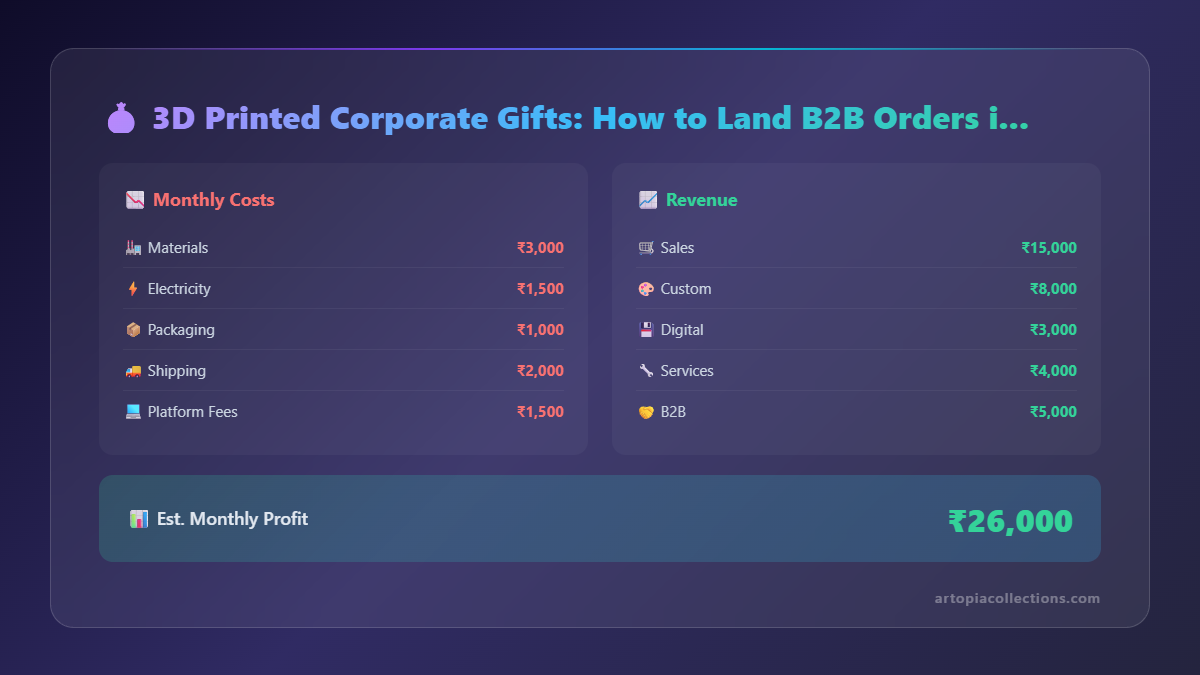 Yes, India is a price-sensitive market. Companies will always look for a good deal. But the smart ones, the ones you *want* to work with, also understand value. Don't just compete on being the cheapest. Emphasize the uniqueness, the customization, the quality, and the local support you offer. Highlight that a memorable 3D printed gift builds a stronger brand connection than a generic imported item. Sometimes, a slightly higher price for a truly unique item is easily justifiable when you explain the benefits properly.
3. Be Ready for "Yesterday" Deadlines
This is a common one, isn't it? "Can we get 500 units by next week for a sudden event?" You'll hear it. A lot. It's important to be realistic about your capacity, but also to show flexibility where you can. Having a few trusted printers (like my trusty Creality Ender 3 V2s or a faster Anycubic Kobra 2 Neo) humming away gives you that crucial buffer. And always, always over-communicate on timelines. If you can't hit it, be upfront immediately.
Landing Those Orders: From Lead to Delivery
Okay, you're convinced. So how do you actually go about finding these clients and sealing the deal?
Finding the Right Leads
 This is where the real hunt begins. And look, I know what you're thinking, "LinkedIn? Really, Vidyut?" But trust me on this one, it's a goldmine. Seriously, get on LinkedIn. Search for HR Managers, Marketing Heads, Procurement Officers in companies you admire or companies within a specific industry you want to target (e.g., IT, manufacturing, education). Connect with them. Don't immediately pitch. Start by engaging with their posts, share relevant industry insights. Once you've built a tiny bit of rapport, then you can send a polite message introducing your unique offering. "Hey, I saw you're looking for innovative ways to engage employees; we specialize in custom 3D printed corporate gifts that really stand out." Something like that.
Beyond LinkedIn, local business associations and chambers of commerce are fantastic. Attend their events. Carry some impressive samples. Just talking to people face-to-face still works wonders. And don't forget your own online presence. Make sure your website (or even just an Instagram page) showcases your best corporate gift examples. By the way, if you want to see some of the stuff we've already done or get some ideas for your own custom gifts, check out our products page at Artopia Collections.
The Pitch & Prototype Power-Up
Once you have a lead, the goal isn't just to tell them about 3D printing; it's to show them how it solves *their* problem (i.e., finding unique, memorable gifts). Always, always have physical samples. A beautifully printed coaster with a generic logo, a custom pen holder, a small trophy. These aren't just objects; they're conversation starters. They ignite ideas. "Oh, we could put our product on that!" or "Our logo would look amazing here!"
And here's the deal: offer a prototype. This is crucial. For a promising lead, I usually print a prototype, even if it's just one piece, and courier it to them. Costs me a bit, sure, maybe ₹200-₹300 for courier and filament, but it makes all the difference. Seeing their logo, their idea, physically manifested makes the concept real. It builds trust and shows you're serious. Sometimes I charge a small design fee for complex prototypes, but often, for a potential large order, I'll waive it.
Pricing Your Masterpieces (Without Underselling Yourself)
Ah, pricing. This is where many of us struggle. My mantra is: Don't undersell yourself. Your time, your design skills, your printer's hum – it all has value. Here’s how I break it down:
- Material Cost: This is easy. How much filament (e.g., eSUN PLA+ for ₹1600-₹2000/kg) does it take per piece? Don't forget supports!
- Electricity: Often overlooked! Your printers run for hours. Factor in the per-unit cost of electricity in your area. For a large print farm, this adds up significantly.
- Printer Depreciation/Maintenance: Your printer isn't immortal. Factor in wear and tear, nozzle replacements, and eventual upgrades.
- Design Time: If you're designing from scratch or heavily modifying a model, this is your professional fee. Price it per hour.
- Print Time: How long does it take for *one* piece to print? Multiply that by your desired hourly rate for machine operation.
- Post-Processing: Sanding, deburring, removing supports, painting, assembly, quality checks. This is manual labor. Again, hourly rate.
- Packaging & Logistics: Don't forget the cost of boxes, bubble wrap, and courier charges for delivery.
- Overhead: Rent (if you have an office), internet, software subscriptions, etc. Spread this across your orders.
Once you have your true cost per piece, add your profit margin. For bulk orders, you can afford to slim down the margin per piece but make up for it in volume. For example, a custom keychain might cost you ₹20 in material and electricity. For 100 pieces, you might quote ₹80-₹100 each. For 1000 pieces, maybe ₹50-₹60. But a one-off sample could be ₹250. Also, always have a Minimum Order Quantity (MOQ). Mine is usually 25-50 pieces for custom corporate items. It helps filter out the time-wasters.
Scaling Up and Keeping Clients Happy
You’ve landed a big order! Congrats! Now comes the production and delivery part.
Production Prowess
This is where your print farm earns its keep. Make sure you have enough reliable machines. Stock up on common filament colors – black, white, grey, and any specific company brand colors your clients might need. Buying in bulk (e.g., 5-10kg spools of PLA) can save you a bit of cash too. Quality control is paramount. Every single piece with a company logo represents their brand, and by extension, your business. Inspect each print carefully before packaging. One bad print can sour a client relationship, and believe me, you don't want that.
Post-Sale and Retention
The deal isn't done when the delivery is made. A happy client is a repeat client, and honestly, the best advertisement you can get. Follow up a week or two after delivery. Ask for feedback. Ask if they’d be willing to give a testimonial or share photos of the gifts in use. Offer them a small discount on their next order. Keep them in the loop about new materials or design possibilities you're exploring. Building that long-term relationship is how you secure recurring B2B income.
Common Challenges and My Two Pennies
It's not all sunshine and perfectly adhering first layers, of course. You'll face challenges. One big one is competing with mass-produced items from China. Companies might balk at your per-piece price compared to some cheap plastic trinket they found online. Your job is to educate them on the value: the local support, the customization, the quality, the uniqueness, and the shorter lead times you can offer compared to international shipping. Explain that it’s an investment in their brand, not just a commodity.
Another challenge can be managing design expectations. Some clients will have elaborate ideas that are either too complex, too expensive, or too fragile for FDM printing. Be honest and guide them towards feasible, robust designs. Sometimes, a simpler, elegant design is far more impactful than a overly complex one that breaks easily. And remember those "yesterday" deadlines? Don't be afraid to say no if it's genuinely impossible. It's better to decline an order than to promise something you can't deliver and damage your reputation.
Ready to Print Your Way to B2B Success?
Look, running a small business, especially in 3D printing, can feel like a constant grind. But shifting focus to the B2B corporate gift market has been a game-changer for my business, Artopia Collections. It provides a steady flow of interesting projects and the opportunity to really showcase what 3D printing can do beyond just hobbyist prints. It takes hustle, persistence, and a willingness to build relationships, but the rewards are absolutely worth it.
So, dust off those business cards, update your LinkedIn profile, and start thinking big. Your print farm isn't just for fidget toys anymore. It's a powerful tool for crafting memorable corporate connections. Go out there and make some amazing things happen!